Showing posts with label Vermeer. Show all posts

6 November 2025

The da Vinci code

Develop your senses, 
especially learn how to see.....


Per sviluppare una mente completa studia la scienza dell'arte, studia l'arte della scienza. Sviluppa i tuoi sensi, impara soprattutto a vedere. Comprendi che tutto รจ connesso.

[Principles for the Development of a Complete Mind: Study the science of art. Study the art of science. Develop your senses - especially learn how to see. Realise that everything connects to everything else.]

Leonardo da Vinci
Principles for the Development of a Complete Mind


This was not my first visit to Dedham Vale, the Stour Valley, and Flatford Mill. I have photographed these places, and written about them (please see below) before, and have endeavoured to follow the instruction of Leonardo.....  Basic questions arise:  what does it matter if a painting of a Haywain is an effective, accurate, realistic representation in two dimensions of something seen by the artist?  Or, what if it is a composite made from various seeings?  Or what if it is an imaginary recreation of something similar witnessed elsewhere?

Flatford Mill, 1930 - Frances Hodgkins (1869-1947)


I have just got back from a brief trip that encompassed something of Essex and Suffolk, and then parts of London and London galleries and exhibitions, and my mind is ablaze with glorious art and autumn colour, while also being  confused and disturbed by personal and emotional vortices that include differences between my daughters, memories of my late wife, and hopes for the future.....  Realise that everything connects to everything else (Leonardo da Vinci).


So, if I photograph Willy Lott's cottage, whether in sunshine or in overcast cloudy light, whether with a swan in the foreground or with a friend on the wall, what does that mean?  What does it tell us about the price of fish?  Does it help anyone?  Did it help anyone that John Constable painted it, and that it is still there?


We walk along the Stour, from Flatford to Dedham, and back, in sunshine one day and under grey skies the next..... The pollarded willows reach back into the past, and yearn for an untroubled future:


Some are broken by wind and weight, living alone and un cared for:


A kingfisher eludes my lens, splashing into the water then winging to a hiding place amongst the falling leaves:


Is this art?  Or is it life?  It changes by the moment, and it slips through our fingers, much as we might try to clutch it to our hearts:


We visit the house where Gainsborough lived, in Sudbury. It is an extraordinary mixture of ancient and new, without seeming rhyme or reason. There is no sense of the artist's presence, but I do learn that he was a landscape artist who, along with Jacob van Ruisdael, would have been a considerable influence on the young Constable:


Then we drive to Kenwood House, frustrated by traffic and a lack of parking, to see two paintings by Vermeer, or not.  Two versions of the same picture, The Guitar Player, are remarkably similar, thought the girl's hairstyle differs.  It is thought that the later version could be a copy by Vermeer himself, though others think it could have been painted by his daughter.  Whatever the truth, the nature of art again makes us think, though what we think may remain a mystery.....


Also in Kenwood House is a picture by Constable, of one of the ponds on Hampstead Heath, the sky rich in coloured airs and water vapour.  


Every day ends with the dying of the sun, and yet every day is different. Sometimes it is beautiful; other times we regret the coming of the dark:


The next morning the trees in Kensington Gardens are glorious:


And Peter Doig blows Yusef Lateef softly at us from 1950s wooden Klangfilm Euronor speakers in the Serpentine Gallery.....


His exhibition, House of Music, lets the Lion of Judah roam free in imaginary landscapes, dancing to the music of time.....


Outside, London confuses and baffles. Part rustic idyll, not so unlike Flatford:


Part individual loneliness amongst the crowds:


And part urban jungle, a labyrinth beneath the towering constructions that shelter so many closed windows:


In Tate Britain I find Peter Doig again, though this time without the soundtrack:


Echo Lake, 1998 - Peter Doig (1959 - )


And then we immerse ourselves in the starry world of Lee Miller, whose extraordinary career spanned fifty or so years and several continents, and whose work stretched from Vogue and glamour:


To the violence and horror of the Second World War, but which took in artistic experimentation on the way:


Model with Lightbulb, 1943 - Lee Miller


It has been a busy few days, and I am tired now, my mind filled with images and confusing thoughts. I recently read that Dr Tony Woods, researcher at Kings College London, said: The research clearly shows the stress-reducing properties of viewing original art and its ability to simultaneously excite, engage and arouse us.

Interesting....

But it can also be exhausting.....

I also read recently that: exposure to nature activates the parasympathetic nervous system – the branch of the nervous system related to a “resting” state. This instils feelings of calm and wellbeing that enable us to think more clearly and positively, (Sam Pyrah, The Guardian)....


The falling leaves drift by the window
The autumn leaves of red and gold
I see your lips, the summer kisses
The sun-burned hands I used to hold

Autumn Leaves
Johnny Mercer, Jacques Prevert


Why does the eye see a thing more clearly in dreams than the imagination when awake? 

Leonardo da Vinci


*****

Please also see:


*****

[For November 2nd]


******


22 February 2023

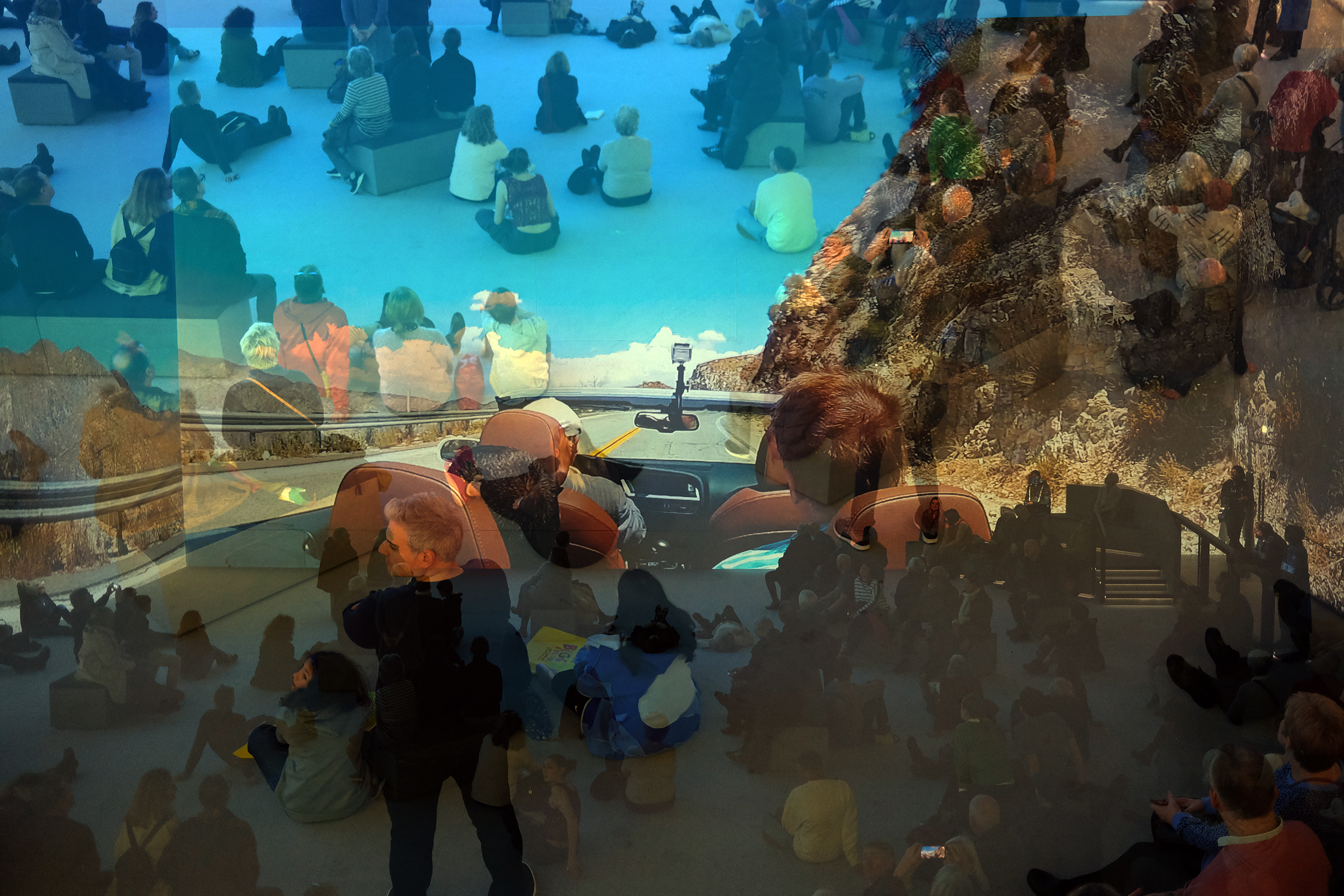
David Hockney - Bigger & Closer

 Love Life 


David Hockney: Bigger and Closer review – an overwhelming blast of passionless kitsch


This was the heading of Jonathan Jones's two star review, posted on February 21st 2023.  In his piece he wrote that, Gigantic projections of the painter’s work fill entire walls in this immersive audiovisual extravaganza – but there is no real art to catch the memory or move the soul....


I wonder exactly what your definition of real art is, Mr Jones?


I saw the show today, and I enjoyed it thoroughly.  I found it engaging and eye-opening and it was a wonderful contrast to the grey damp London day outside. And a wonderful contrast to the miserable world of politics and economics that enshrouds us.  


I am not a stranger to art galleries, and I would love to be able to spend time, for instance, in the Rijksmuseum in Amsterdam admiring (studying?) the Vermeer exhibition (though it has been sold out for weeks)..... I suppose that is your idea of real art, Mr Jones?


Video footage of David Hockney driving friends through Malibu Canyon in California with Wagner on the stereo may well not count as real art, but then I am not sure that Warhol's Marilyn, or Edvard Munch's The Scream are quite up there with Rembrandt's The Night Watch.....


This is a very clever, visually entertaining and instructive (to me, at least) show. There are sequences, with a commentary by Hockney himself, which explain something of his "art."


And there are episodes, shall we say, about various periods of, and developments in, his "art."  We may not be able to appreciate the brush work, nor to linger for as long as we may choose in front of the "real thing," but we can be immersed in something of the light and the experience.....  From California:


To the woods of Yorkshire:


The colours of winter trees:


The colours of summer fields:


The sunshine of Normandy:


And there are ideas expressed - ideas, or, perhaps, to be fair, opinions - on aspects of art and photography, such as this idea gained from a drive through the Alps into Switzerland:


Mr Jones makes some fair points about the way this show dodges from one thing to another, and about how Hockney could have been more explicit about some of his work, rather than, perhaps telling us that Brunelleschi got it wrong (though the Chinese got it right - did I understand that?  Does it matter?)

But Mr Jones ends his critique with this: He (Hockney) is sceptical of the camera’s rule over our eyes yet it’s a sad fact that, in this kind of spectacle, photography and film clips have more reality than drawings and paintings. So Hockney in his innocence has lent his fame here to a dumb contemporary fad that doesn’t – and cannot – capture the beauty of his art. It’s ultimately like seeing a great artist through the wrong end of a telescope – smaller and further away.

The phrase, dumb contemporary fad is really not helpful.  Do we have to go back to red dye on a cave wall for authenticity?  Wasn't painting on damp plaster a dumb contemporary fad once?  Leonardo (in Milan) got it wrong, but, amongst others, Michelangelo and Raphael got it right (in Rome). Shouldn't we be glad they persevered?

At least Mr Jones uses the term great artist to describe Mr Hockney, but the way he does it is condescending to both Mr Hockney and to me.  I am no art critic, but I know what I like.....


You try so hard but you don't understand 
Just what you will say when you get home 
Because something is happening here but you don't know what it is 
Do you, Mr. Jones?

Ballad of a Thin Man

Bob Dylan


As David Hockney himself says: The world is very very beautiful if you look at it, but most people don’t look very much. They scan the ground in front of them so they can walk, they don’t really look at things incredibly well, with an intensity. I do.


Thank you, David Hockney.


I recommend you see this show for yourselves....


12 February 2015

Amsterdam and The Hague - The Netherlands - Part 2 - Golden Age

Musรฉes des Beaux Arts....


My visit to Den Haag (The Hague) is singleminded. I have not come to watch the Dutch Parliament in session; to attend the application of the convention on the prevention and punishment of the crime of genocide (CROATIA v. SERBIA) at the International Court of Justice; to visit one of the largest Apple Stores in the oldest shopping arcade in the Netherlands, nor to take a dip off the beach at unpronounceable Scheveningen (apparently this was the word used to get German spies to give themselves away)..... This is a lightning raid on The Mauritshuis, a recently renovated jewel in the crown of the Dutch Golden Age.


Meisje met de parel,
Johannes Vermeer, c 1665


As the publicity says, the girl is back in town, and I have a date.....  Her home was designed and built in 1644 by Jacob van Campen, the most famous architect of his time (who also provided Rembrandt with his grand home in Amsterdam). Count Johan Maurits van Nassau-Siegen (1604-1679) commissioned it, hence its name, but he was not at home when I called.  


The new main entrance to The Mauritshuis (or you can take the glass lift)


The museum has recently undergone extensive refurbishment and modernisation which provide an airy and bright entrance lobby, as well as extended space for new exhibitions.  But the original interior, even when lit with LED systems which are calibrated to blend daylight with candleglow is as designed in the seventeenth century.  As Laura Cumming wrote in The Observer, the Mauritshuis is the ideal museum.  It's a home from home for art.  The rooms are on a human scale.....  Vermeer's Girl, for all her Mona Lisa fame, is in a modest wood-panelled chamber..... 


Jan Brueghel the Elder and Peter Paul Rubens,
The Garden of Eden with the Fall of Man, c. 1615

Primary Art - a teacher and her rat instruct young minds....


It is a place to muse, and to amuse. The Greek origin of the word museum denoted a place or temple dedicated to the Muses. Hence it has come to mean a building set apart for study and the arts. One of the more famous pictures on show here is itself of a lesson - Rembrandt's justly acclaimed The Anatomy Lesson of Doctor Nicolaes Tulp (1632).....


Dr Tulp's Anatomy Lesson: Aris Kindt, armed robber, executed by hanging


As Jonathan Jones commented in The Guardian, the eye is led irresistibly into a dark tunnel between the arm's exposed muscles - and into the body itself. Rembrandt leads the onlooker from the visible world to the invisible darkness within. What lies there?


Self-portrait with Lace Collar, 1629


As Rembrandt himself looks confidently out at the viewing public, I muse on what it is that I am seeing. Why have I come all this way? Jonathan Jones suggests that, the true reason to come here is to encounter some of the world's most profound works of art. Perhaps I should have spent more time in Den Haag, and visited the International Court of Justice. It is fitting perhaps that the Mauritshuis and the Peace Palace are near neighbours. Somehow I feel that Vermeer and Rembrandt still work as ambassadors for peace, and that whatever else we gain from great art the very act of admiring such works is in itself an act of peace:


About suffering they were never wrong,
The old Masters: how well they understood
Its human position: how it takes place
While someone else is eating or opening a window or just walking dully along;


But I hasten to Amsterdam.....


And go straight to the also recently refurbished Rijksmuseum, a great palace of art, exhausting in its dimensions and in its scope. 


The Rijksmuseum is the museum of the Netherlands.  It was first opened in 1800 (ironically in Den Haag), but moved to Amsterdam in 1808 and then to its current location in 1885. It has recently been extensively refurbished, and when I was last here, about five years ago, less than half the collection was on view.  


Rembrandt's De Nachtwacht, 1642


Now there is more than enough.  I mean, much more.  From the Middle Ages through the Golden Age, to Dutch Colonialism, to (almost) now.  Guess who I find looking a little uneasy beneath all the pomp and splendour?


Vincent Van Gogh, Self-Portrait with Grey Felt Hat (1886-87)

Everywhere there are talking points, pictures to amuse, artefacts, sculptures, allegories, portraits.  Sometimes, I almost feel the models are here to admire themselves....


But what leads me out, takes me from myself here are the pictures of life....  In the Mauritshuis there were wonderful pictures of life, by Jan Steen for example, and here, with David Teniers, in his Peasant Kermis (1665), you get an impression of the world as it is.  I particularly like the complex visions of village activity in winter, like this:


Winter Landscape with Ice Skaters
, Hendrick Avercamp, 1608


But I also enjoy the pictures that you could almost walk out into, like this Amsterdam canal scene, though there are fewer cars (or bicycles!) and more leaves on the trees in this picture than now.....


Jan van der Heyden, Amsterdam View with Houses on the Herengracht.... (1670)


And outside, this elegant city is a museum in itself. The canals reflect the buildings and light fills the windows, and the shifting shapes of the narrow-fronted houses bring to mind the world with which de Hooch and Vermeer might have been familiar.


And the waters of the canals, the bridges and boats, cannot have changed that much.....


And the sky, the sense of space and the vanishing points, are still in the air.....


It is not difficult to dream a little in Amsterdam. Musing in the galleries and then wandering one way or another, time hangs lightly draped across your shoulders. The canals seep an atmosphere of quiet. At the Vishuisje Herengracht I have a snack of oysters and a delicious herring broodje (sandwich) and feel that the world is not such a bad place after all.


And in the Cafe Bouwman, close by, I make a new friend (though I understand that felines are no longer allowed in bars by law....)


In the Vondelpark, the willows do not so much weep as relax, their tendrils hair-like in the winter cool....


And on the canals themselves, as dusk gathers, the lights glow warm and welcoming.....


My trip to Amsterdam was not singleminded. I was not only there for the Museum.  Even when ice and snow gather and life slows to winter rhythms....


And over the water sails a boat, just like back then


Though it is cold outside, Peace comes dropping slow in this most picturesque of places.....  And the evening closes with supper with a family of old friends who live overlooking one of the quieter canals. On the third floor of what once was a convent school we eat and drink and discuss the politics of museums, the nature of the Netherlands, and the passing of time. 

Good night, Amsterdam......  Let's drink to another Golden Age!


How, when the aged are reverently, passionately waiting
For the miraculous birth, there always must be
Children who did not specially want it to happen, skating 
On a pond at the edge of the wood....

W H Auden