Showing posts with label Roger McGough. Show all posts

2 October 2025

In Memoriam Poetarum

 RIP - may they rest in poetry.....


Someone once said to me that, 'Poets are at the forefront of language.....'  And that does make sense, in a way, though who is to define a poet?  Or who can really define poetry?  From Homer to Chaucer to Byron to John Cooper Clarke, via William McGonagall, and via every child who has made up a rhyme, there are poets everywhere, in every language.....

But then there are those whose poetry resonates, whose words remain, and whose words make a difference to others.  For me, the greats include W B Yeats, Robert Frost and Edward Thomas, but then the list goes on and on, and I want to remember Keats, and Causley, Hughes and Heaney, Montale and Mayakovsky, Brecht and Blake.....

There is an extraordinary richness out there, some stored in people's memories, some stored in libraries and bookshops, on private shelves and in dusty attics. 

And the lives of poets come and go, passing time as time passes us all.  And just this week, we have lost two more voices of our age.  On September 29th, Brian Patten (1946-2025), and three days earlier Tony Harrison (1937-2025).  

And as the great survivor, Roger McGough, says:

Let me die an oldman's death
a clean and in between the sheets holy water death
famous last words?  You must be joking death
been there, done it, seen it all before, death
Corruption, greed, can't take any more, death

It will be our turn soon.....


All those years ago Brian wrote to me (I was proposing a book) about his friend, Roger:  He has priests hands, don't you think?  (Adrian has childs hands.  I'm looking at mine now. But we can never see ourselves.  That's one reason to distrust primary sources.) Another reason is that the primary sources might not like the sauce.....

In memoriam Brian Patten, a man of love, a man of playful, deeply felt words.  As he wrote, in One another's light,

But it's hard to guess
How one thing on another
Works an influence.
We pass - 
And lit briefly by one another's light
Think the way we go is right.


I met R S Thomas (1913-2000) in Cambridge, when he had just driven himself from the wilds of Wales to read at a conference.  He was a craggy, austere man, but his observations were clear and gentle:

A poem that always went down well with my students was Poetry for Supper, which has two old poets, Hunched at their beer in the low haze/Of an inn parlour, discussing poetry, while the talk ran/Noisily by them, glib with prose.....

                                     'You speak as though
No sunlight ever surprised the mind
Groping on its cloudy path.'

'Sunlight's a thing that needs a window
Before it enters a dark room
Windows don't happen.'


Adrian Henri (1932-2000), and his girlfriend Catherine, stayed with us in Italy when I persuaded him to visit in the wake of his pal, Roger McGough.  Adrian was a larger than life character, an artist, playwright and poet, and he thoroughly enjoyed performing for my school, enlisting the support of a bluegrass group of friends to perform a talking blues, among other highlights. 

As a painter, his poetry is more visual than his Liverpudlian mates, but this one, Poet in School, appropriate in the context of his visit to my school, tells a painful story:

'Write about
something that's happened to you
or someone you know.'  Half an hour
to go, and still nothing written.
Just sitting, face blank as the empty sheet,
shuffling his feet.  'Come on, son,
you must know something that's happened
to someone.'  'No, Sir.'
'Your family, your friends?'
'Sir, my brother's best mate died.'
'How?'  'Sir, electrocuted.  A train...'
'Was he on the track?'  'Sir...'
The empty eyes fill with tears.
Somehow the years between us
aren't enough to take the words back.


Adrian Mitchell (1932-2008) first came into my life when he performed, with, among others, Allen Ginsberg, Gregory Corso and Christopher Logue, in Wholly Communion at the Royal Albert Hall in 1965.  His poem, To Whom It May Concern, with the refrain Stick my legs in plaster/Tell me lies about Vietnam, made him famous, perhaps, as it combined incisive rhythm with arresting images spoken in his gentle but insistent voice.

Later I encountered him at Lancaster University, where he was friends with my mentor David Craig.  And then I met him again in 1992 at Lerici, with others including Dannie Abse (1923-2014) and the Italian poet Paolo Bertolani (1931-2007), to celebrate the bicentenary of Shelley's birth, and I took the opportunity to invite him and his wife, Celia, to Rome.  

Adrian read at my school (St George's - at the time it was St George's English School, Rome.....  now it is changed - utterly changed.....) In the morning he read a poem (I am not sure, but I think it might have been Victor Jara of Chile - look it up - ) and my then Headmaster said he thought that Adrian should not read it that evening.  I mentioned this, dutifully, to Adrian, who read it very clearly that evening.....

But, in memoriam, after all, this is the poem to remember Adrian by:

Beattie Is Three

At the top of the stairs
I ask for her hand. O.K.
She give it to me.
how her fist fits my palm,
A bunch of consolation.
We take our time
Dow the steep carpet way
As I wish silently
That the stairs were endless.


At a tangent, perhaps, Edwin Morgan (1920-2010) was a very different poet. He was a professor (prior to early retirement in 1980) at Glasgow University. He also had connections with David Craig, and I met him when I lived in Lancaster. His poetry was tense, acerbic, and inventive in an ultimately modern way. Some of his writings belonged to the school of concrete poetry, where shape was the prime issue; but he also translated poetry from Russian, Hungarian, French, Italian, Latin, Spanish, Portuguese, German, and other languages.  A poem that affected my students particularly was In the Snack-Bar, which tells of an old man with disability seeking help to go to the toilet in a cafe and then taking a bus.  Another that inspired young listeners was, The First Men on Mercury, where invasive beings exchange greetings with indigenes, and then leave changed.

Glasgow 5 March 1971, one of his "Instamatic" poems, clicks like a photograph, an instant in the life of a city, a moment in life's timeline that shocks and makes us pause, and think, and wonder about outcomes:

With a ragged diamond 
of shattered plate-glass
a young man and his girl
are falling backwards into a shop window.
The young man's face
is bristling with fragments of glass
and the girl's leg has caught
on the broken window
and spurts arterial blood
over her wet-look white coat.
Their arms are starfished out
braced for impact,
their faces show surprise, shock,
and the beginning of pain.
the two youths who have pushed them
are about to complete the operation
reaching into the window
to loot what they can smartly.
Their faces show no expression.
It is a sharp clear night
in Sauchiehall Street.
In the background two drivers
keep their eyes on the road.


Jonty Driver (1939-2023) was a friend of my parents, and we got to know each other towards the end of his life. He was a South African, and was active in the anti-apartheid movement, became a political prisoner, and latterly a school master and a poet.  Not everyone loved Jonty, and in Private Eye, on February 11th 1978, Auberon Waugh wrote in his diary, GOOD NEWS that C J Driver, whoever he may be, is going away to teach in Hong Kong and will not be reviewing any more novels for the Guardian.....  Although, Waugh goes on, Lorna Sage is undisputed as Lord Gnome Trophyholder for Most Boring Reviewer of All Time, Driver comes second with his record-breaking three-year run of picking dud novels.....

Not for me to make war with a Waugh, but, certainly in my experience and later in his life,. Jonty was an engaging and entertaining observer of life, and, when I last saw him read, at the Sea Fever Festival in Wells-next-the-Sea in Norfolk, he carried off the persona of poet with grace and clarity.

In his last book, Still Further, there is a poem entitled Sunset & After which, I think, expresses common humanity in a way that all can relate to:

The tide is out, the sand is firm beneath
my feet, the sun about to set.  I'm here
again on Noordhoek Beach.  Another day
is sauntering to its casual end.
I've journeyed back from where I don't belong
to where I also don't belong......

The point of being here is not revealed;
perhaps you'd find it out from time to time
and wander on, pretending that you had
a plan.  Not true, as far as I'm concerned.
If God has worked His purpose out, He's not told me.... 


Of all these gifted and imaginative men, the one I was most in awe of was Tony Harrison (1937-2025) who died just a week ago, aged 88.  Initially approachable, and affable, Tony concealed a cauldron of thoughts and ideas, and attempts at light-heartedness seemed brittle. He read his poems as if they were wrought from hard material - carved, as it were, from blocks of words.  Marked with D. (where D stood both for Dad and Death) a poem about the cremation of his father, who had been a baker, begins:

When the chilled dough of his flesh went in an oven
Not unlike those he fuelled all his life,
I thought of his cataracts ablaze with heaven
and radiant with the sight of his dead wife.....


I listened, and tried to note his intonation, and any changes between my text and his recital, and was swirled in a sea of words and images.  Poetry has potential, a power that perhaps no longer works against the competition of electronic wizardry.

At the end of his reading, Harrison turned to A Kumquat for John Keats, a relatively long poem about what happens if you don't die young, about what it feels like to live in a world that has the possibility of total extinction.  That febrile state where we know not what will become of us while we still should be alive:

I find I can't, as if one couldn't say
exactly where the night became the day,
which makes for me the kumquat taken whole
best fruit, and metaphor, to fit the soul
of one in Florida at 42 with Keats
crunching kumquats, thinking, as he eats
the flesh, the juice, the pith, the pips, the peel,
that this is how a full life ought to feel,
its perishable relish prick the tongue,
when the man who savours life's no longer young,
the fruits that were his futures far behind.
Then it's the kumquat fruit expresses best
how days have darkness round them like a rind,
life has a skin of death that keeps its zest.


It is sad that those we love pass away before us.  We mourn the silence that fills our lives where conversations and laughters once shone like silver and gold.  But we know that this is life, and we know we have our memories.  With poetry we are blessed by the remaining words, on paper or in our minds.  And, for those who remain it is good to rehearse the life of others as it is good to love the life that we still hold.

Some thirty years ago I was attempting to write a book about Roger McGough, and I sent a draft of the first part to Brian Patten.  I asked him to be honest, and he was.  I found it interesting but now and then it sounds a bit chummy, he typed....  Perhaps there could be a bit more background colour....  I suppose in any biog the background against which a life is lived is hugely important and maybe more of that is needed.


Brian then hand-wrote a footnote:  I really hope you don't find my comments dispiriting at all,

Very Best

Brian


And the very best to you, Brian, and all in the afterlife.  

Where would we be without you?


The Gulf of Lerici - 1992


....and the scent to winged flowers,

and the coolness of the hours

of dew, and sweet warmth left by day,

were scattered o'er the twinkling bay...


P B Shelley

Lines written in the bay of Lerici


[for 02/11]


6 September 2025

Ingoland, My Ingoland

I will arise and go now....

Roger McGough at St Mary's, Snettisham, September 3rd, 2025

Meteorological autumn already. Season of fruits and mellifluous substances.  I am up early and out, walking to the sea, breathing the fresh, slightly sharp air, 


enjoying a feeling of peace. Sometimes the world is too much with us, but not this morning. Sunflowers turn their heads to the rising sun, 


while berries ripen, grateful for the recent showers.


I love Ingoland (my name for the area of Norfolk where I live, drained by the river Ingol) or even Engerland, the land where my mother lay labouring to give me life.  I have always loved you.  From the days of branch lines, 


and steam trains, from the days of Winnie the Pooh, or where Trevor Dudley-Smith (Elleston Trevor) mused By A Silver Stream, I have lived and loved in a sweet bubble of family and friends, of farmers and hauliers in Sussex, of aunts and uncles and cousins in London and beyond.  I have loved Dame Edna Everage, Dame Kiri te Kanawa, Duke Ellington, Count Arthur Strong and others of the no(a)bility. I love village churches,


And old vicarages; Laurence Sterne and William Cowper, John Donne and George Herbert.


I used to drink in Levenshulme with Kendo Nagasaki and my friend Spen, who had done time for manslaughter as he came home from the army and found his wife in bed with another man, whose skull, it turned out, wasn’t adapted to a blow from a soldier.  I ate cow’s udder sandwiches with a workmate at Viner’s in Sheffield, swapped Raymond Chandler novels with Angela Lansbury’s uncle at Brown Bailey’s. I was a student when uprisings were de rigeur. I drank too much on occasions, and ate what I could from Lancaster market, wandered lonely as a clown in the Lake District, and fell into impossible love in Scotland, twice.....  Old flames, now dowsed.....


It was my country.  The country of Nelson.  The country of Shakespeare and Joyce and W B Yeats (You sure?  Ed.)


But I, being poor, have only my dreams;
I have spread my dreams under your feet;
Tread softly because you tread on my dreams.


W B Yeats

He Wishes For the Cloths of Heaven


We had Sooty and Sweep.  Andy Pandy.  The Flowerpot Men.  Bruce Lacey.  Mr Pastry.  We played in bombed out buildings and air-raid shelters.  There were two tv channels, and we only had one, and I had to go to Denys's house to watch The Lone Ranger....


Then, around the time that JFK and Pope Giovanni XXIII hit the big sleep, the Beatles wanted to hold my hand, and I grew a little bit up, (thank you Jackie Short, et alios....)


And along came the Liverpool Poets, Roger McGough, Adrian Henri and Brian Pattern, and her majester Lily the Pink with a scaffold to uphold her....  And life turned from B & W to colour.  From 350 lines to 525.  And, eventually, from analogue to digital.


And perhaps that’s where it went awry?  We used to drink ententes cordiales, and get along with our neighbours – after all, in 1966 we made amends for WWII in a penalty shootout, when I was at Warcop Army Camp.  What was going to go wrong?


Which brings me to Mr McGough....  


He has just been to stay.  He came to perform his show, “Alive and Gigging,” (not as some promoters would have it, “Alive and Giggling,”) at St Mary’s, Snettisham, the high church of Ingoland, and we had a wonderful evening.  Full house, many laughs, a few tears, much reflection on the world we have grown to inhabit.  


But there’s the rub.  


All the while, there’s an acid eating away at this world, dissolving the things we hold/held dear. My grandparents, and my parents, wore uniforms and lost their youths defending a world they believed in.  A generation stood against fascism and beat it back and proved it wrong.


But like the Hydra, it has come back, fag ash and Burberry, fake tan and golfing cheats, a creeping, crawling resurgence of things that ought to have drowned in sewers.  And we are all affected, all conflicted.  I want to love my enemas.  I could even give Nadine Doilies space (she, like me, never made it to the Hows of Lourds) but, like Martin Loofah’s reformation, the slate was not whipped clean and so there is still the seed of disquiet, the worm of hatred.  


Angerland, My Angerland....  So....


I must arise and go now, and go to Italy,
And a small cabin build there, of clay and bottles made:
Nine lean-tos will I have there, a cave for my honey-bee;
And live apart in the free-trade grave.


And I shall have some peace there, for peace comes dropping slow.....


Who am I/are you kidding?  We are all caught in the sticky spider’s web of life.  We are as insects who eat the world and leave nothing useful behind.  It is too easily beautiful to walk out on the shores of Ingoland and to ignore what is going on all around.  


Ow!  Ow! brief candle!
I’m but a walking shadow, a poor player
That struts and frets my hour upon the stage
And then is heard no more.


Which is why we are off to Italy.....  Better the devil you don’t know.....


I love my Engerland.  I love my country of birth, but I am not English.  I am not British.   I cannot fly the flag of some obscure saint who was probably martyred at Diospolis, now Lydda, in what was Palestine, around the end of the third or the beginning of the fourth century.  I am as English as W B Yeats, as James Joyce.  I am a European, and am uncomfortably proud of that. Don’t paint my house with red crosses. Don’t paint the roundabouts with symbols of some kind of purity.  Around 12.000 years ago no one lived here.  We are all migrants or descended from such.  No one is pure anything.


And to return to the beginning of this piece.  I have just had the privilege, honour and pleasure of hosting Roger McGough in my house.  At 87 years of age, in that awkward period between birth and death, he still raises a giggle and pokes fun at the world.  Whether you would consider him a National Treasure or not, some have called him the Patron Saint of Poetry.  Others say he has done more for poetry than champagne has done for weddings.  I would say he has brought light into a dark world and made many many people feel better about their worries.


At breakfast he told me of a poem-in-progress. I don’t have total recall, but it was about the stink of politics, and the punch line (yes, poems are like jokes) was that the Speaker of the House of Commons was calling for quiet....  “O Dour!  O Dour!  O Dour!


Arrest my case.....  


We are bound for Italy, where at least somethings are different.....


This is for Roger and my other fellow travellers through this world.


I am land.
I am happy for you live on me.
Till and plough, graze your cattle,
build your homes upon me.
I will feed, nourish, even bury you
But I am not yours.

Not yours to fight over.
To invade and plunder, divide and destroy.
I do not belong to you.
Even though you claim me, I am not yours.
I have no name, flag or anthem
Call me World.

Roger McGough
Call Me World


16 March 2023

Song Snatcher

 Love Minus Zero/No Limit


Performing for Amnesty International - Yes, that is Adrian Mitchell on the left.....


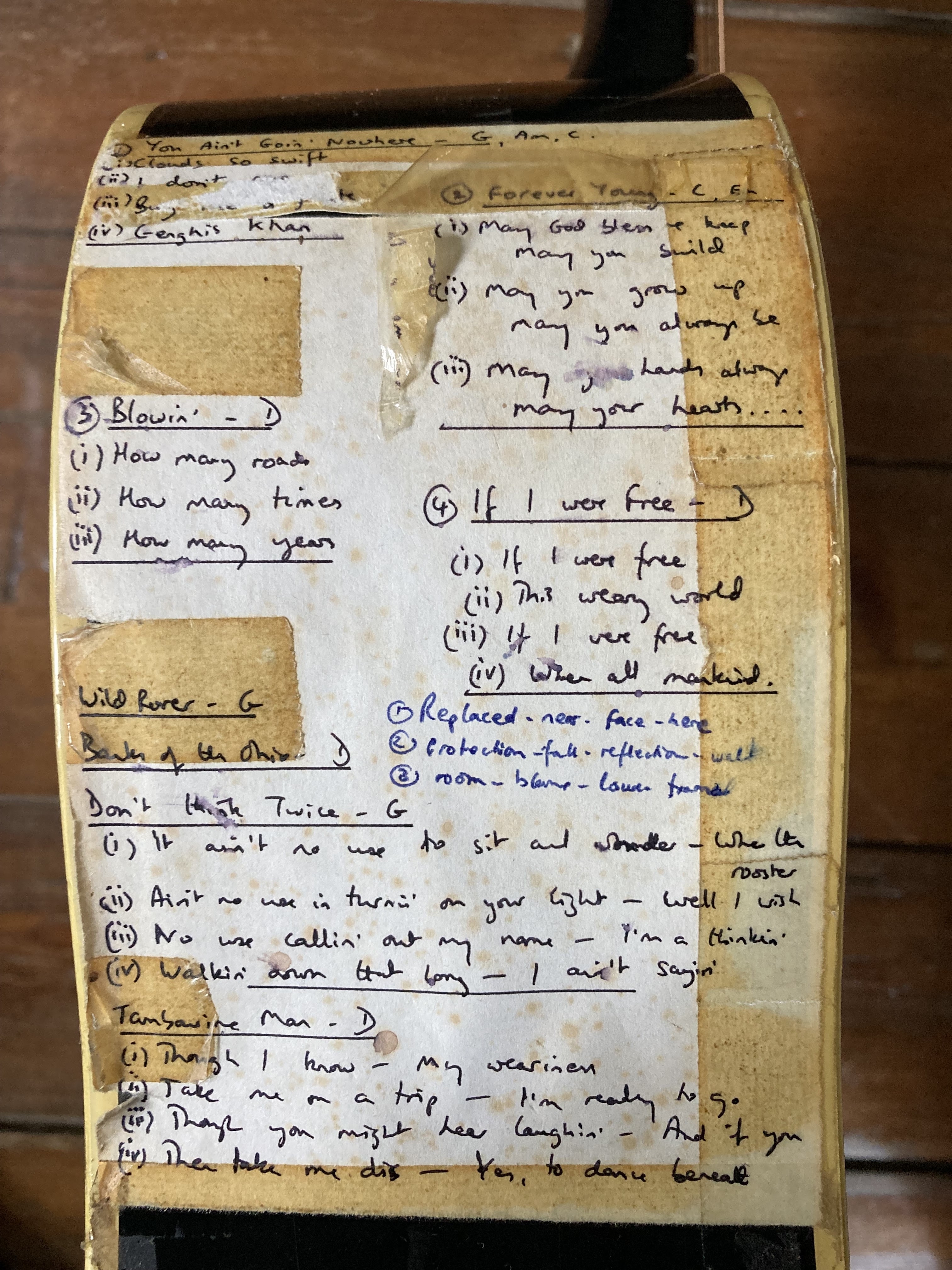
Last night I had a dream.  Somehow, I was to sing a song.  I think it was at an event at my wife, Amanda’s, Care Home, so there would be a small audience – maybe some twenty or thirty.  My son-in-law has recently loaned me his Martin acoustic guitar, though I have not practised for years.  


Thanks, Cam - I'll look after it


In the dream I had the guitar, and I had several books of words and chords.  These were the books that I had written out when a teenager (I had my first, cheap, guitar, when I was about twelve).  I can see them now, flimsy exercise books with my handwriting in royal blue ink underlined on the cover, then songs written out with the chords over the words in red biro.


Some of the first songs I learned were simple American songs, cowboy songs, copied from Alan Lomax’s American Songbook, and probably heard on Two-Way Family Favourites on the radio on Sundays.  


Then there was Peter, Paul and Mary and Joan Baez, and Bob Dylan with some more modern material – Blowin’ in the Wind, etc.  


My guitar playing was simplicity itself – three chords if I was lucky, and none of them with a barré (so B minor was a problem) and my sense of rhythm less than strict. I was no singer, either, though perhaps later on my voice pleased some.


Anyway, I was there with the guitar and my song books, but then, as I seemed to be on a stage now, with a gathering audience, I panicked a bit.  I couldn’t find the books, I had put them somewhere but I was now lost.  I was never good at remembering all the words, and, I had had a crib stuck on the shoulder of my guitar with the first words of lines or verses to help me.


But I get ahead of myself.


For many years I just played a bit with friends.  I was a very minor part of a group led by school mate ‘Niggles,’ with Nick on Bass, Ben as vocalist, and Roy Dodds (yes, THE Roy Dodds) on drums.  I remember we played at parties, but my contribution was minimal.  I don’t think anyone noticed.


Picture taken on Dunrobin Beach, Sutherland, for the local press


I made some progress however when another friend, Charlie Snoxall, gave me a better guitar, and it was with this that I went to Scotland before my eighteenth birthday.  There I met Paul and Derek and we formed The Dunrobiners (for more about this period you can see an earlier Blog, entitled “Highlands,” https://www.richardpgibbs.org/2014/06/highlands.html) quickly becoming sought after for Ceilidhs and pubs, and even making a record (long since disappeared, don’t even try to find it....)  I remember one evening when we drove up to Wick in Paul’s Rover 90 to perform at a folk club.  The headline act was Hamish Imlach (I think!) and we played with him – but that’s about all I recall..... 


Paul, Derek and me at The Stag's Head, Golspie in 1969
I loved that silk shirt (until I dropped hot cigarette ash on it!)


Later that summer we did a week in the front room of The Stag’s Head, Golspie, and I still smell the tables of Tennent’s Heavy that accumulated before us as we worked through our repertoire of traditional Scottish and Irish songs, including The Irish Rover (She had twenty-three masts and she stood several blasts....)Leaving of Liverpool (So fare thee well my own true love....), and my speciality, The Black Velvet Band (Her eyes they shone like diamonds/You’d think her the queen of the land/And her hair it hung over her shoulder/Tied up with a black velvet band), the whole room joining in for the chorus. Apart from that I spent time trying to impress the Assistant Matron (the gorgeous Marty Dearlove) by plucking my way through The Last Thing on my Mind, my eyes sticking to her like snails on a window pane, while she darned the boarders’ socks (Are you going away with no word of farewell/Will there be not a trace left behind?


Not a trace.....


Around the same time, I also spent holidays in Ireland and met Luke Kelly, in Dublin (for more on this see my Dublin 3 Blog https://www.richardpgibbs.org/2012/10/dublin-3_28.html).  I learned a little from singers and guitarists, but, to be honest, I wasn’t a very good musician.  I had a few party pieces – Season of the Witch (When I look out my window), being one, Mr Tambourine Man (Let me forget about today until tomorrow.....) another.


Several years later, in Rome, friends formed Roisin Dubh, the Celtic connection being strong at the time, and I bought a new (Echo) guitar, which stayed in tune a little better than my old one.  With a friend and colleague, Gerry, I set up a folk group at our school, and we practised and sang loud and happily for some years.  It was, interestingly, a very cosmopolitan group, including Palestinians and Israelis as well as British and Italians, and we performed at concerts that I set up for Amnesty International, headlined by the likes of Adrian Mitchell and Roger McGough, with songs like I shall be released (They say ev’rything can be replaced....)


One iteration of our folk group in Rome


On my return to the UK I tried to keep going, but family life and then, eventually, my wife’s illness withered the vine.


And so, to my dream.  I am now searching furiously for my word books, sweating and frightened, the enormous audience restless (we are in something like the Ryman Auditorium now), but I am lost, and my soft fingers are not practised.


I stand and there is a hush.  I decide to talk about memory, and memory loss, and try to illustrate this with snatches from some of the songs I used to sing, plucking hopefully at the guitar.  At my door the leaves are falling/The cold wild wind will come/Sweethearts walk by together/And I still miss someone..... (Johnny Cash).  I struggle to complete the song, and then talk some more about my personal history as I have told you, dressing up my encounters with musicians and singers, grasping at memories of lines.  Things begin to fall into place, I see my light come shining/from the west unto the east/Any day now, any day now/I shall be released....


Danny, Andrew and Clive


My confidence grows, my fingertips harden, I use a pick, Must be the season of the witch!  I talk a bit about dementia, about the way my wife has lost all language, I strum a chord, and begin Love minus zero: (My love, she speaks like silence....) I falter.....  I begin Don’t Think Twice It’s All Right, but muddle the verses:  Well it ain’t no use to sit and wonder why babe, If’n you don’t know by now.....


The audience is standing, No wait!  I say.  I just remembered.  One more.....


May God bless and keep you always, May your wishes all come true,

May you always do for others and let others do for you,

May you build a ladder to the stars and climb on every rung,

May you stay for ever young

For ever young, for ever young, May you stay forever young.....


The auditorium is dark and empty.  The audience has gone.  The auditorium has gone.  I am in my wife’s Care Home, in the Dining Room; Amanda is asleep, head down on the table.  The cook brings me a cup of tea.  Very nice, she says.  You should go on Britain’s got talent......


Love Minus Zero/No Limit


My love she speaks like silence
Without ideals or violence
She doesn’t have to say she’s faithful
Yet she’s true, like ice, like fire
People carry roses
Make promises by the hours
My love she laughs like the flowers
Valentines can’t buy her


Bob Dylan