Showing posts with label Adrian Mitchell. Show all posts

2 October 2025

In Memoriam Poetarum

 RIP - may they rest in poetry.....


Someone once said to me that, 'Poets are at the forefront of language.....'  And that does make sense, in a way, though who is to define a poet?  Or who can really define poetry?  From Homer to Chaucer to Byron to John Cooper Clarke, via William McGonagall, and via every child who has made up a rhyme, there are poets everywhere, in every language.....

But then there are those whose poetry resonates, whose words remain, and whose words make a difference to others.  For me, the greats include W B Yeats, Robert Frost and Edward Thomas, but then the list goes on and on, and I want to remember Keats, and Causley, Hughes and Heaney, Montale and Mayakovsky, Brecht and Blake.....

There is an extraordinary richness out there, some stored in people's memories, some stored in libraries and bookshops, on private shelves and in dusty attics. 

And the lives of poets come and go, passing time as time passes us all.  And just this week, we have lost two more voices of our age.  On September 29th, Brian Patten (1946-2025), and three days earlier Tony Harrison (1937-2025).  

And as the great survivor, Roger McGough, says:

Let me die an oldman's death
a clean and in between the sheets holy water death
famous last words?  You must be joking death
been there, done it, seen it all before, death
Corruption, greed, can't take any more, death

It will be our turn soon.....


All those years ago Brian wrote to me (I was proposing a book) about his friend, Roger:  He has priests hands, don't you think?  (Adrian has childs hands.  I'm looking at mine now. But we can never see ourselves.  That's one reason to distrust primary sources.) Another reason is that the primary sources might not like the sauce.....

In memoriam Brian Patten, a man of love, a man of playful, deeply felt words.  As he wrote, in One another's light,

But it's hard to guess
How one thing on another
Works an influence.
We pass - 
And lit briefly by one another's light
Think the way we go is right.


I met R S Thomas (1913-2000) in Cambridge, when he had just driven himself from the wilds of Wales to read at a conference.  He was a craggy, austere man, but his observations were clear and gentle:

A poem that always went down well with my students was Poetry for Supper, which has two old poets, Hunched at their beer in the low haze/Of an inn parlour, discussing poetry, while the talk ran/Noisily by them, glib with prose.....

                                     'You speak as though
No sunlight ever surprised the mind
Groping on its cloudy path.'

'Sunlight's a thing that needs a window
Before it enters a dark room
Windows don't happen.'


Adrian Henri (1932-2000), and his girlfriend Catherine, stayed with us in Italy when I persuaded him to visit in the wake of his pal, Roger McGough.  Adrian was a larger than life character, an artist, playwright and poet, and he thoroughly enjoyed performing for my school, enlisting the support of a bluegrass group of friends to perform a talking blues, among other highlights. 

As a painter, his poetry is more visual than his Liverpudlian mates, but this one, Poet in School, appropriate in the context of his visit to my school, tells a painful story:

'Write about
something that's happened to you
or someone you know.'  Half an hour
to go, and still nothing written.
Just sitting, face blank as the empty sheet,
shuffling his feet.  'Come on, son,
you must know something that's happened
to someone.'  'No, Sir.'
'Your family, your friends?'
'Sir, my brother's best mate died.'
'How?'  'Sir, electrocuted.  A train...'
'Was he on the track?'  'Sir...'
The empty eyes fill with tears.
Somehow the years between us
aren't enough to take the words back.


Adrian Mitchell (1932-2008) first came into my life when he performed, with, among others, Allen Ginsberg, Gregory Corso and Christopher Logue, in Wholly Communion at the Royal Albert Hall in 1965.  His poem, To Whom It May Concern, with the refrain Stick my legs in plaster/Tell me lies about Vietnam, made him famous, perhaps, as it combined incisive rhythm with arresting images spoken in his gentle but insistent voice.

Later I encountered him at Lancaster University, where he was friends with my mentor David Craig.  And then I met him again in 1992 at Lerici, with others including Dannie Abse (1923-2014) and the Italian poet Paolo Bertolani (1931-2007), to celebrate the bicentenary of Shelley's birth, and I took the opportunity to invite him and his wife, Celia, to Rome.  

Adrian read at my school (St George's - at the time it was St George's English School, Rome.....  now it is changed - utterly changed.....) In the morning he read a poem (I am not sure, but I think it might have been Victor Jara of Chile - look it up - ) and my then Headmaster said he thought that Adrian should not read it that evening.  I mentioned this, dutifully, to Adrian, who read it very clearly that evening.....

But, in memoriam, after all, this is the poem to remember Adrian by:

Beattie Is Three

At the top of the stairs
I ask for her hand. O.K.
She give it to me.
how her fist fits my palm,
A bunch of consolation.
We take our time
Dow the steep carpet way
As I wish silently
That the stairs were endless.


At a tangent, perhaps, Edwin Morgan (1920-2010) was a very different poet. He was a professor (prior to early retirement in 1980) at Glasgow University. He also had connections with David Craig, and I met him when I lived in Lancaster. His poetry was tense, acerbic, and inventive in an ultimately modern way. Some of his writings belonged to the school of concrete poetry, where shape was the prime issue; but he also translated poetry from Russian, Hungarian, French, Italian, Latin, Spanish, Portuguese, German, and other languages.  A poem that affected my students particularly was In the Snack-Bar, which tells of an old man with disability seeking help to go to the toilet in a cafe and then taking a bus.  Another that inspired young listeners was, The First Men on Mercury, where invasive beings exchange greetings with indigenes, and then leave changed.

Glasgow 5 March 1971, one of his "Instamatic" poems, clicks like a photograph, an instant in the life of a city, a moment in life's timeline that shocks and makes us pause, and think, and wonder about outcomes:

With a ragged diamond 
of shattered plate-glass
a young man and his girl
are falling backwards into a shop window.
The young man's face
is bristling with fragments of glass
and the girl's leg has caught
on the broken window
and spurts arterial blood
over her wet-look white coat.
Their arms are starfished out
braced for impact,
their faces show surprise, shock,
and the beginning of pain.
the two youths who have pushed them
are about to complete the operation
reaching into the window
to loot what they can smartly.
Their faces show no expression.
It is a sharp clear night
in Sauchiehall Street.
In the background two drivers
keep their eyes on the road.


Jonty Driver (1939-2023) was a friend of my parents, and we got to know each other towards the end of his life. He was a South African, and was active in the anti-apartheid movement, became a political prisoner, and latterly a school master and a poet.  Not everyone loved Jonty, and in Private Eye, on February 11th 1978, Auberon Waugh wrote in his diary, GOOD NEWS that C J Driver, whoever he may be, is going away to teach in Hong Kong and will not be reviewing any more novels for the Guardian.....  Although, Waugh goes on, Lorna Sage is undisputed as Lord Gnome Trophyholder for Most Boring Reviewer of All Time, Driver comes second with his record-breaking three-year run of picking dud novels.....

Not for me to make war with a Waugh, but, certainly in my experience and later in his life,. Jonty was an engaging and entertaining observer of life, and, when I last saw him read, at the Sea Fever Festival in Wells-next-the-Sea in Norfolk, he carried off the persona of poet with grace and clarity.

In his last book, Still Further, there is a poem entitled Sunset & After which, I think, expresses common humanity in a way that all can relate to:

The tide is out, the sand is firm beneath
my feet, the sun about to set.  I'm here
again on Noordhoek Beach.  Another day
is sauntering to its casual end.
I've journeyed back from where I don't belong
to where I also don't belong......

The point of being here is not revealed;
perhaps you'd find it out from time to time
and wander on, pretending that you had
a plan.  Not true, as far as I'm concerned.
If God has worked His purpose out, He's not told me.... 


Of all these gifted and imaginative men, the one I was most in awe of was Tony Harrison (1937-2025) who died just a week ago, aged 88.  Initially approachable, and affable, Tony concealed a cauldron of thoughts and ideas, and attempts at light-heartedness seemed brittle. He read his poems as if they were wrought from hard material - carved, as it were, from blocks of words.  Marked with D. (where D stood both for Dad and Death) a poem about the cremation of his father, who had been a baker, begins:

When the chilled dough of his flesh went in an oven
Not unlike those he fuelled all his life,
I thought of his cataracts ablaze with heaven
and radiant with the sight of his dead wife.....


I listened, and tried to note his intonation, and any changes between my text and his recital, and was swirled in a sea of words and images.  Poetry has potential, a power that perhaps no longer works against the competition of electronic wizardry.

At the end of his reading, Harrison turned to A Kumquat for John Keats, a relatively long poem about what happens if you don't die young, about what it feels like to live in a world that has the possibility of total extinction.  That febrile state where we know not what will become of us while we still should be alive:

I find I can't, as if one couldn't say
exactly where the night became the day,
which makes for me the kumquat taken whole
best fruit, and metaphor, to fit the soul
of one in Florida at 42 with Keats
crunching kumquats, thinking, as he eats
the flesh, the juice, the pith, the pips, the peel,
that this is how a full life ought to feel,
its perishable relish prick the tongue,
when the man who savours life's no longer young,
the fruits that were his futures far behind.
Then it's the kumquat fruit expresses best
how days have darkness round them like a rind,
life has a skin of death that keeps its zest.


It is sad that those we love pass away before us.  We mourn the silence that fills our lives where conversations and laughters once shone like silver and gold.  But we know that this is life, and we know we have our memories.  With poetry we are blessed by the remaining words, on paper or in our minds.  And, for those who remain it is good to rehearse the life of others as it is good to love the life that we still hold.

Some thirty years ago I was attempting to write a book about Roger McGough, and I sent a draft of the first part to Brian Patten.  I asked him to be honest, and he was.  I found it interesting but now and then it sounds a bit chummy, he typed....  Perhaps there could be a bit more background colour....  I suppose in any biog the background against which a life is lived is hugely important and maybe more of that is needed.


Brian then hand-wrote a footnote:  I really hope you don't find my comments dispiriting at all,

Very Best

Brian


And the very best to you, Brian, and all in the afterlife.  

Where would we be without you?


The Gulf of Lerici - 1992


....and the scent to winged flowers,

and the coolness of the hours

of dew, and sweet warmth left by day,

were scattered o'er the twinkling bay...


P B Shelley

Lines written in the bay of Lerici


[for 02/11]


16 March 2023

Song Snatcher

 Love Minus Zero/No Limit


Performing for Amnesty International - Yes, that is Adrian Mitchell on the left.....


Last night I had a dream.  Somehow, I was to sing a song.  I think it was at an event at my wife, Amanda’s, Care Home, so there would be a small audience – maybe some twenty or thirty.  My son-in-law has recently loaned me his Martin acoustic guitar, though I have not practised for years.  


Thanks, Cam - I'll look after it


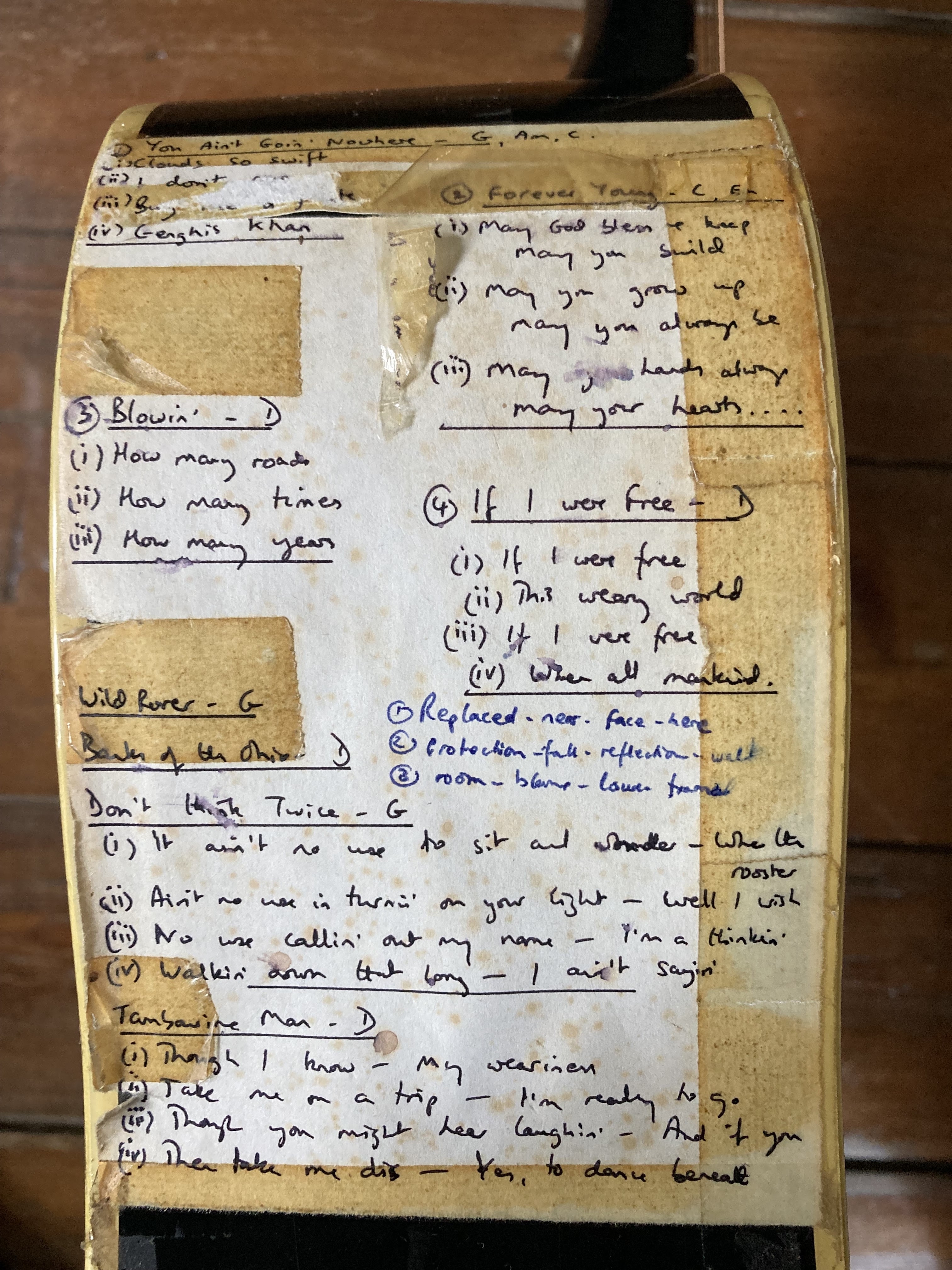
In the dream I had the guitar, and I had several books of words and chords.  These were the books that I had written out when a teenager (I had my first, cheap, guitar, when I was about twelve).  I can see them now, flimsy exercise books with my handwriting in royal blue ink underlined on the cover, then songs written out with the chords over the words in red biro.


Some of the first songs I learned were simple American songs, cowboy songs, copied from Alan Lomax’s American Songbook, and probably heard on Two-Way Family Favourites on the radio on Sundays.  


Then there was Peter, Paul and Mary and Joan Baez, and Bob Dylan with some more modern material – Blowin’ in the Wind, etc.  


My guitar playing was simplicity itself – three chords if I was lucky, and none of them with a barré (so B minor was a problem) and my sense of rhythm less than strict. I was no singer, either, though perhaps later on my voice pleased some.


Anyway, I was there with the guitar and my song books, but then, as I seemed to be on a stage now, with a gathering audience, I panicked a bit.  I couldn’t find the books, I had put them somewhere but I was now lost.  I was never good at remembering all the words, and, I had had a crib stuck on the shoulder of my guitar with the first words of lines or verses to help me.


But I get ahead of myself.


For many years I just played a bit with friends.  I was a very minor part of a group led by school mate ‘Niggles,’ with Nick on Bass, Ben as vocalist, and Roy Dodds (yes, THE Roy Dodds) on drums.  I remember we played at parties, but my contribution was minimal.  I don’t think anyone noticed.


Picture taken on Dunrobin Beach, Sutherland, for the local press


I made some progress however when another friend, Charlie Snoxall, gave me a better guitar, and it was with this that I went to Scotland before my eighteenth birthday.  There I met Paul and Derek and we formed The Dunrobiners (for more about this period you can see an earlier Blog, entitled “Highlands,” https://www.richardpgibbs.org/2014/06/highlands.html) quickly becoming sought after for Ceilidhs and pubs, and even making a record (long since disappeared, don’t even try to find it....)  I remember one evening when we drove up to Wick in Paul’s Rover 90 to perform at a folk club.  The headline act was Hamish Imlach (I think!) and we played with him – but that’s about all I recall..... 


Paul, Derek and me at The Stag's Head, Golspie in 1969
I loved that silk shirt (until I dropped hot cigarette ash on it!)


Later that summer we did a week in the front room of The Stag’s Head, Golspie, and I still smell the tables of Tennent’s Heavy that accumulated before us as we worked through our repertoire of traditional Scottish and Irish songs, including The Irish Rover (She had twenty-three masts and she stood several blasts....)Leaving of Liverpool (So fare thee well my own true love....), and my speciality, The Black Velvet Band (Her eyes they shone like diamonds/You’d think her the queen of the land/And her hair it hung over her shoulder/Tied up with a black velvet band), the whole room joining in for the chorus. Apart from that I spent time trying to impress the Assistant Matron (the gorgeous Marty Dearlove) by plucking my way through The Last Thing on my Mind, my eyes sticking to her like snails on a window pane, while she darned the boarders’ socks (Are you going away with no word of farewell/Will there be not a trace left behind?


Not a trace.....


Around the same time, I also spent holidays in Ireland and met Luke Kelly, in Dublin (for more on this see my Dublin 3 Blog https://www.richardpgibbs.org/2012/10/dublin-3_28.html).  I learned a little from singers and guitarists, but, to be honest, I wasn’t a very good musician.  I had a few party pieces – Season of the Witch (When I look out my window), being one, Mr Tambourine Man (Let me forget about today until tomorrow.....) another.


Several years later, in Rome, friends formed Roisin Dubh, the Celtic connection being strong at the time, and I bought a new (Echo) guitar, which stayed in tune a little better than my old one.  With a friend and colleague, Gerry, I set up a folk group at our school, and we practised and sang loud and happily for some years.  It was, interestingly, a very cosmopolitan group, including Palestinians and Israelis as well as British and Italians, and we performed at concerts that I set up for Amnesty International, headlined by the likes of Adrian Mitchell and Roger McGough, with songs like I shall be released (They say ev’rything can be replaced....)


One iteration of our folk group in Rome


On my return to the UK I tried to keep going, but family life and then, eventually, my wife’s illness withered the vine.


And so, to my dream.  I am now searching furiously for my word books, sweating and frightened, the enormous audience restless (we are in something like the Ryman Auditorium now), but I am lost, and my soft fingers are not practised.


I stand and there is a hush.  I decide to talk about memory, and memory loss, and try to illustrate this with snatches from some of the songs I used to sing, plucking hopefully at the guitar.  At my door the leaves are falling/The cold wild wind will come/Sweethearts walk by together/And I still miss someone..... (Johnny Cash).  I struggle to complete the song, and then talk some more about my personal history as I have told you, dressing up my encounters with musicians and singers, grasping at memories of lines.  Things begin to fall into place, I see my light come shining/from the west unto the east/Any day now, any day now/I shall be released....


Danny, Andrew and Clive


My confidence grows, my fingertips harden, I use a pick, Must be the season of the witch!  I talk a bit about dementia, about the way my wife has lost all language, I strum a chord, and begin Love minus zero: (My love, she speaks like silence....) I falter.....  I begin Don’t Think Twice It’s All Right, but muddle the verses:  Well it ain’t no use to sit and wonder why babe, If’n you don’t know by now.....


The audience is standing, No wait!  I say.  I just remembered.  One more.....


May God bless and keep you always, May your wishes all come true,

May you always do for others and let others do for you,

May you build a ladder to the stars and climb on every rung,

May you stay for ever young

For ever young, for ever young, May you stay forever young.....


The auditorium is dark and empty.  The audience has gone.  The auditorium has gone.  I am in my wife’s Care Home, in the Dining Room; Amanda is asleep, head down on the table.  The cook brings me a cup of tea.  Very nice, she says.  You should go on Britain’s got talent......


Love Minus Zero/No Limit


My love she speaks like silence
Without ideals or violence
She doesn’t have to say she’s faithful
Yet she’s true, like ice, like fire
People carry roses
Make promises by the hours
My love she laughs like the flowers
Valentines can’t buy her


Bob Dylan


28 February 2022

To whom it may concern


To Whom It May Concern


A tissue, a tissue, we all fall down.....


I was run over by the truth one day.
Ever since the accident I’ve walked this way
So stick my legs in plaster
Tell me lies about Vietnam.

Heard the alarm clock screaming with pain,
Couldn’t find myself so I went back to sleep again
So fill my ears with silver
Stick my legs in plaster
Tell me lies about Vietnam.

Every time I shut my eyes all I see is flames.
Made a marble phone book and I carved all the names
So coat my eyes with butter
Fill my ears with silver
Stick my legs in plaster
Tell me lies about Vietnam.

I smell something burning, hope it’s just my brains.
They’re only dropping peppermints and daisy-chains
So stuff my nose with garlic
Coat my eyes with butter
Fill my ears with silver
Stick my legs in plaster
Tell me lies about Vietnam.

Where were you at the time of the crime?
Down by the Cenotaph drinking slime
So chain my tongue with whisky
Stuff my nose with garlic
Coat my eyes with butter
Fill my ears with silver
Stick my legs in plaster
Tell me lies about Vietnam.

You put your bombers in, you put your conscience out,
You take the human being and you twist it all about
So scrub my skin with women
Chain my tongue with whisky
Stuff my nose with garlic
Coat my eyes with butter
Fill my ears with silver
Stick my legs in plaster
Tell me lies, tell me lies about Aghanistan.
Tell me lies about Israel.
Tell me lies about Congo.
Tell me, tell me lies Mr Bush.
Tell me lies Mr B-B-Blair, Brown, Blair-Brown.
Tell me lies about Vietnam.

Adrian Mitchell
1932 - 2008

Adrian read the original draft of this poem at the International Poetry Incarnation in the Royal Albert Hall in 1965, and added to it throughout his life. He read it when I was a student at Lancaster; and he read it when he and Celia came to visit my school in Rome, (despite a warning from the then Headmaster that he shouldn't.....)


Somewhere up the creek.... without the proverbial paddle

Although the Vietnam war is history now, and generations have grown up without the pictures of American bodybags on the TV news every night; even without the daily flashes of Blair and Brown, the spectre of war has not left us, and this poem was brought to mind once more by Nick Cohen's excoriating piece, headed Lies come in all shapes and sizes. This government is familiar with them all in The Observer on February 13th this year: https://www.theguardian.com/commentisfree/2022/feb/12/lies-lies-and-more-lies-a-government-built-on-lies-is-incapable-of-anything-else 

To quote but two sentences: This is a government that lies. It lies because it is a lame-duck administration of charlatans and clowns, an echoing void where the government of the country ought to be.


No tracks, no trains.....


This is a government that pretends to be working day and night to protect the people of Ukraine, but on the news this morning a British couple in Ukraine with two small babies had been told by the British Embassy that they had to drive for 14 hours across a war zone to acquire documentation that would enable them to return to the UK. Today we hear that the Foreign Secretary, Ms Truss, has enraged (Ras) Putin by her undiplomatic errors sufficiently to drive him to threaten the use of nuclear weapons.....


The people's party.....


Last weekend a Government Minister suggested that refugees from Ukraine could enter the UK with visas if they picked fruit or vegetables.  Last week the Prime Minister proposed to sanction a smattering of Russian individuals and organisations, but conveniently avoided his friendship with Baron Lebedev, of Hampton in the London Borough of Richmond upon Thames and of Siberia in the Russian Federation (ennobled by Johnson in 2020), perhaps because he, like the Prime Minister, has dual nationality; or perhaps even more worryingly, Lubov Chernukhin, the wife of Putin’s former deputy finance minister Vladimir Chernukhin (Pandora papers documents published in October last year suggest he was allowed to leave Russia in 2004 with assets worth about £350m and retain Russian business links). She is now a member of the Conservatives’ 14-strong "advisory board" of donors, with a habit of handing the party six-figure sums.....  For more on this, please see John Harris's article:
The fight for Ukraine is a fight for liberal ideals. So how can Boris Johnson possibly lead it? published on February 27th: https://www.theguardian.com/commentisfree/2022/feb/27/ukraine-liberal-ideals-boris-johnson-tories-russian-money


Shadows in the sands....


There may well be those who won't agree with me, but Dictator Putin's vile and deranged attack on Ukraine had long been in gestation, with the West's paltry opposition to his incursions into Crimea and Georgia effectively encouraging his disregard for democratic values (not to mention his unpunished murders on the streets of the UK). But the way that the UK was bamboozled into Brexit, possibly with Russian assistance (the 'Russian report' was stifled by Johnson for nine months.....https://www.theguardian.com/world/2020/jul/21/just-what-does-the-uk-russia-report-say-key-points-explained), was another string to his bow. The weakness of the UK now, insular and no longer a part of a united Europe (despite still being part of NATO and the UN), gave succour to the megalomania of the ex-KGB officer.  Vain words from Downing Street can no longer convince anyone that Britain is a world power, although, with a little luck, they may chime with those from other sources.

So, with apologies to Adrian, 

Tell me lies, tell me lies about Afghanistan.
Tell me lies about Israel.
Tell me lies about Congo.
Tell me, tell me lies Mr Trump.
Tell me lies Mr Cameron, Mr Osborne, Mr Johnson.
Tell me lies about Ukraine.


If only you could fly.....

*     *     *     *

I do hope that Adrian Mitchell wouldn't mind the liberties taken here....  I have tried to contact Celia just to check, but so far without success.  If by any chance any of Adrian's family should see this and have any objection please let me know directly....


*     *      *     *


17 May 2013

Amnesia International

Someone must have slandered Josef K., for one morning, without having done anything truly wrong, he was arrested.” 
Franz Kafka:  "The Trial"


The St George's Ukulele Orchestra

Imagine the knock on the door, the urgent, unfriendly, unexpected, unexplained demands.  Imagine being taken, roughly, into a vehicle, into a room, into a cell, into the dark.  You don't understand.  You have done nothing wrong.  But no one comes.  You are within four walls, the ceiling and the floor.  You haven't the strength to blow the walls down,  The single window, out of reach, shows the sky but through a mesh of bars.  The bed is hard, the door is fast, the pan is stained.  No one comes.  You have not done anything truly wrong.  Imagine the knock on the door.  Imagine the hand on your elbow in the street.  Two men aside you.  The waiting vehicle.  Imagine the four walls.  The ceiling and the floor.  

You have not done anything truly wrong.  Your conscience is clear. 

There's a knock at the door.


For many of us the world is a breezy, comfortable place.  We have no real enemies, and with the good fortune of family and employment we truck along, from cradle to grave, without too many thorny hurdles.  The occasional vaccination.  The eye tests.  The occasional speeding fine..... (the wife to take the points).....

But within this world of ours there are yet many injustices, many insecurities, and many hidden infamies.  Shortly after the end of the Second World War, the United Nations came to an agreement:

The Universal Declaration of Human Rights, which was adopted by the UN General Assembly on 10 December 1948, was the result of the experience of the Second World War. With the end of that war, and the creation of the United Nations, the international community vowed never again to allow atrocities like those of that conflict happen again.

And so came into existence an agreement, which was agreed to by a majority of sensitive and civilised nations, that declared:

"Now, Therefore THE GENERAL ASSEMBLY proclaims THIS UNIVERSAL DECLARATION OF HUMAN RIGHTS as a common standard of achievement for all peoples and all nations, to the end that every individual and every organ of society, keeping this Declaration constantly in mind, shall strive by teaching and education to promote respect for these rights and freedoms and by progressive measures, national and international, to secure their universal and effective recognition and observance, both among the peoples of Member States themselves and among the peoples of territories under their jurisdiction."

On May 28th 1961,  British Lawyer Peter Benenson published an article in "The Observer," entitled "The Forgotten Prisoners" in defence of two Portuguese students imprisoned for seven years by the Salazar regime for raising their glasses to freedom, and Amnesty International was born.


As a teacher (whatever that really means) I have seen it my duty to attempt to educate young people in the ways of the world, without force and without  bias.  There are those who hold a view that Amnesty International is a left wing, subversive organisation, but that is not the case.  Its work is careful and its case studies are cross referenced to avoid adversarial positions.  It bases its investigations on well-grounded, up-front information, and they recur always to the UDHR.  By default there will be more people on the receiving end of AI's interventions who are left of centre, but this could just be because there is a tendency for extreme right wing regimes to be oppressive (though extreme left wingers can be extremists too).


It is great that wherever I have worked, there have been young people willing to give up time, energy and effort to support the needs of others.  Naturally this happens in many ways, such as buying raffle tickets, or wearing non-uniform, but one of the most exciting facets of this in my career has  been the staging of concerts where individuals have given their talents for free to raise money to support the campaigns for the lost and forgotten.


It has been a privilege to work with friends and young people who are energetic in their wishes to procure justice so my position has been humbled, but it is not essentially about us or me: it is about the disappeared, the forgotten, the lost and lonely - and there are so many.

One of Amnesty International's problems recently has been the diversification of the demands on its expertise, and the diverse interests of its leaders.  There are many and varied campaigns.  Perhaps too many? There is so much going on that the organisation is at risk of splitting apart at the seams, like a shirt on a growing child.

Although I abhor the death penalty, I feel less strongly about it under certain circumstances than I do about prisoners of conscience.  To put it bluntly if someone commits a heinous crime (for example murdering a child) and the statutory penalty is death, then that capital punishment is justice.  Whereas if someone has a different view to the ruling junta, there is no justification in depriving that person of their freedom or in subjecting them to ill treatment of any kind. The problem is the justice system, not the penalty.  And, as is evident (in for example the United States where those on death row are far more likely to be poor and black than well-to-do and white), justice systems are fallible.  So the irreversibility of the death sentence is a problem.  Yes.....  But the bigger problem to my way of thinking, is that of the individual who hears the knock on the door, and then is spirited away into a semblance of death without recourse to a justice system or to legal representation or trial.  


Just recently I was privileged to work with Fiona and Rhona (as well as a large group of supporters including the witty compère Chris) to put on a show called "A Night out with Amnesty."  The performers, all amateurs and selected from a large number of hopefuls, ranged in age from 11 to 18, and the standard was superb, including stand up comedians, dancers, singers and bands....


The audience, two hundred or more strong, enjoyed the range of talent and supported the largely inexperienced cast with warmth and sympathy, and the overall fund raised by the entertainment and raffle was in excess of £1,100.

The cast of "A Night Out with Amnesty"

It is so easy to forget.  My involvement with Amnesty International goes back years, though I have to admit that my activism has been inconsistent.  Yes I lobbied in parliament for small arms control, and yes I have written letters to leaders and prison governors the world over, but I have been pretty much an arm chair supporter, who hasn't taken many risks.

The idea of concerts to raise money is not a new one, however, and as part of my anti-amnesia campaign I am recalling some great nights from twenty or so years ago, when, as a younger person in Rome, Italy, I managed events involving poets and musicians, but bringing together parents and children in a consciousness-raising way as well.

Adrian Mitchell and kids singing, "I shall be Released."

The late, and great, Adrian Mitchell, came out to Italy, with his wife Celia, specifically to work with us, and he  gave a stirring performance, introducing and reciting his most famous poems, including his "Victor Jara of Chile" (which was not at all approved of by the then Headmaster.)

"They broke the bones in both his hands
They beat his lovely head
They tore him with electric shocks
After two long days of torture they shot him dead

And his hands were gentle
His hands were strong"

Adrian Mitchell in performance

Roger McGough and family came too, and sparkled in tune with the times.  His witty verses and poignant lines entranced the audience and enlivened our lives.  


"Let me die a youngman's death

not a clean and inbetween

the sheets holywater death
not a famous-last-words
peaceful out of breath death"


Roger McGough reading in Rome

And Roger's old Liverpudlian buddy, the late Adrian Henri, graced our presence with his hip hop arty version of poesy.  He hit the spot with his lines to music and gave his all, with love, and a sense of time....


Love Is...


Love is...
Love is feeling cold in the back of vans
Love is a fanclub with only two fans
Love is walking holding paintstained hands
Love is.

Love is fish and chips on winter nights
Love is blankets full of strange delights
Love is when you don't put out the light
Love is

Love is the presents in Christmas shops
Love is when you're feeling Top of the Pops
Love is what happens when the music stops
Love is

Love is white panties lying all forlorn
Love is pink nightdresses still slightly warm
Love is when you have to leave at dawn
Love is

Love is you and love is me
Love is prison and love is free
Love's what's there when you are away from me
Love is... 

Adrian Henri


Poster for Adrian Henri

And then, safely back in the motherland, we had another splendid night in Ascot, with The Spikedrivers.  My students had never heard of them and they were not particularly into 'the blues,' but they surprised themselves by ending up dancing in the aisles to the irresistible drive of the delta boogie.  Great fun.

Signed Flyer for the Spikedrivers

But it is a serious business.  How can we forget?  This paragraph from Associated Press on May 11th this year should remind us:

"Ariel Castro, charged with rape and kidnapping, remained jailed Friday under a suicide watch on $8 million bond while prosecutors weighed more charges, including some that might carry the death penalty."


But this paragraph, from "The Guardian" May 13th should be considered alongside the one above.  Is there not a connection?


"Hunger-strikers being force fed at Guantanamo Bay are shackled to a chair, fitted with a mask and have tubes inserted through their nose and into their stomachs for up to two hours at a time, according to revised guidelines in use at the camp."

How is one a case for the death penalty and the other a case for justice?  How can it be justifiable to keep someone incarcerated for ten years without trial or recourse to basic human rights? We forget what we don't want to know, and we forget what we think we cannot change.  We forget who we are, when faced with threatening forces, when out-talked by the clever or out-boxed by the stronger.  We give up our friends when we need to save our skins.  How can we look at the razor wire and orange suits and shackles of Guantanamo inmates and do nothing?
.
Enshrined in the Universal Declaration of Human Rights are the following articles:

Article 5.
No one shall be subjected to torture or to cruel, inhuman or degrading treatment or punishment.

Article 9.
No one shall be subjected to arbitrary arrest, detention or exile.

Article 10.
Everyone is entitled in full equality to a fair and public hearing by an independent and impartial tribunal, in the determination of his rights and obligations and of any criminal charge against him.


It is time to forget Amnesia, to remember the forgotten, and to drive for an Amnesty for those unjustly and inexplicably imprisoned.  There is no justification for the continuation of Guantanamo, and this inequity simply gives less sophisticated regimes the legitimacy they need in imprinting their injustice on a vulnerable world.

Imagine the knock on the door.  The dark vapours wafting up the stairs.  The curdling of the blood as masked men drag you from your family.


"What do you want to know now?" asks the doorkeeper; "you are insatiable." "Everyone strives to reach the Law," says the man, "so how does it happen that for all these many years no one but myself has ever begged for admittance?" The doorkeeper recognizes that the man has reached his end, and to let his failing senses catch the words roars in his ear: "No one else could ever be admitted here, since this gate was made only for you. I am now going to shut it.”

Franz Kafka:  "The Trial."


Guantánamo Bay opened 11 years ago today. Tell President Obama to close the camp and bring UK resident Shaker Aamer home. View this email online
Amnesty International UK Home
Amnesty International UK
Held in Guantánamo without charge for 11 years. Bring Shaker home.
Shaker Aamer, undated photo.Copyright: US DoD
Shaker Aamer was one of the first to be locked up at Guantánamo Bay, the notorious US detention camp in Cuba, soon after it opened on 11 January 2002. He’s still there now, far away from his wife, children and home in the UK.
Eleven years is a long time to be inside a place like that. And long enough for people on the outside to forget. So today, 11 years on, please show the US authorities that we haven't forgotten – and will never forget - Shaker or the insult to justice that is Guantánamo Bay.
Take Action: Bring Shaker home
Dear Richard,
Former UK resident Shaker Aamer was arrested in Afghanistan in November 2001. He has never been charged, tried or convicted of any crime. His explanation that he was working for a charity at the time of his arrest has never been disproved. The UK authorities have repeatedly asked for him to be returned to the UK where his wife and four children live.
Yet he remains at Guantánamo. Sign our petition: bring Shaker home
'I am dying here every day, mentally and physically… We have been ignored, locked up in the middle of the ocean…'
Shaker Aamer, November 2005

Being held for 11 years on the other side of the world from your family, not knowing if or when you will be released or given a chance to argue your case in court is bad enough, but there’s more.
Shaker alleges he has been tortured both in Guantánamo and before that at Bagram, Afghanistan where during an interrogation he says his head was ‘repeatedly banged so hard against a wall it bounced'.
Much of his time at Guantanamo has been spent in solitary confinement. Punishment, his lawyers believe, for protesting against camp conditions and speaking out on behalf of other inmates.
While Shaker remains defiant, his physical and mental health is failing. He suffers from multiple illnesses including diabetes and arthritis, which lawyers say have been aggravated by inadequate medical care and alleged abuse.
Call on Obama to end Shaker’s ordeal and return him to the UK
Fresh from re-election, President Obama has plenty of new promises to fulfil, but he must also remember the old ones. Such as the commitment he made in January 2009 to resolve the cases of all Guantanamo inmates ‘as promptly as possible’ and close the detention centre within a year.
That deadline has come and gone so we want to give him another date to think about. We’re planning to hand in our petition to Obama on 14 February 2013, the 11th anniversary of Shaker’s personal Guantánamo ordeal.
We need to gather at least 20,000 signatures by then to show that we haven’t forgotten Shaker, we haven’t forgotten Guantánamo and we haven’t forgotten Obama’s promise to close the camp so inmates like Shaker can finally see justice and go home.
Sign our petition: close Guantanamo and bring Shaker home
Thank you,
Amy Summers signature
Amy Summers
Individuals at Risk Campaigner
Take Action: Bring Shaker home
Donate
Supporting Amnesty with a regular gift or donation is the best way you can help us achieve our long term goals.
Your help will allow us to keep up the pressure,
demanding justice for victims of human rights abuses.
Pocket Protest - our SMS action networkFacebookTwitterGoogle+
Privacy PolicyUnsubscribeSend to a friend
Add sct@webmail.amnesty.org.uk to your address book
Copyright © Amnesty international, UK 2012. Registered in England no 01735872, registered office. Amnesty International UK is a company limited by guarantee. Amnesty International UK Section Charitable Trust number 1051681. Questions or feedback? sct@amnesty.org.uk

{~


J91005464897884144734746373615~}


All photos of the St George's event by Alexa Lloyd