There are many good reasons for drinking, and one has just entered my head.....
According to my GP I have a 13%
chance of dying from stroke or heart-related disease within the next 10
years. Or at least that was what he told
me last time I saw him…. I wonder if the
NHS computer programme that throws out this invaluable calculation will have
been ‘doctored’ since the latest guidelines on the consumption of alcohol were
published?

What my GP didn’t say (he’s not
stupid…) was that there is a 100% chance that I will be dead in the future, and
that I will certainly die from something.

For want of a better role model,
I heard that David Hockney’s favourite joke, apparently, goes like this. A
person (note the gender neutrality appropriate to recent government
guidance) goes to the doctor. Patient says, “I would like to live for ever.” Doctor asks if patient smokes and/or
drinks? Patient acknowledges such
vices. Doctor advises stopping smoking
and drinking. Patient asks, “Will I then
live for ever?” Doctor replies, “No but
it will certainly seem like it…..”
Boom! Boom!

Presumably the Government waited
until after the mega-binge of
Christmas and New Year to offer their latest help to individuals who needed
encouragement to enter a dry January.
The fact that currently an average of 29 pubs per week are calling
permanent closing time will mean nothing to the mandarins who wish
(understandably, I admit) to protect public health, but perhaps this
should. At a time when many (and I do
not mean just UKIP and the National Front) wonder where the United Kingdom is
heading, the Government might be advised to read George Orwell’s Saturday Essay on February 9th 1946 in the Evening Standard, The Moon Under Water, to
understand why Britain was once Great?

I am indebted to Olivia Laing, who contributed an
excellent article to last Sunday’s Observer,
entitled, Try to Imagine a Britain

Before you interrupt, I do not
wish to disappear the dangers of alcohol under a sprinkling of biohazard body
fluid spill disposal powder (there are avoidable dangers in excess, just as it is understood that it is best to avoid placing oneself in the path of an oncoming train, whatever the weather.....) But, dear
temperance movement member with your annoying tambourine, is it necessary to eliminate everything that might
be harmful to the human bean? And if so, would it not
make sense to draw up a chart, in rank order, of all the risks we face, and
list them with their respective pros and cons? Where would sugar be? Would
cigarettes still be on sale? Should we
really be allowed to drive two tonne vehicles while talking (even without a mobile phone)?

I had a workmate once, by the
name of Roy Hattersley (no relation) who was a big man. Huge.
Over a breakfast, in a certain Sheffield steel works, of a plate of
everything fried you could imagine, with bread and dripping on the side, a mug
of tea and a pint of milk, he warned me that there was one thing that was bad
for you, which the doctors would not acknowledge, and that was….. WORK!

It’s a commonplace that people
resist advice, and that they persist with habits which may well be bad for
them. But suppose the average man in the
UK
had been following government guidelines up to now. 21 units a week, was it? And now it is 14 (pace, ladies, whatever
the logic, gender equality is forced upon us.) So a pint-a-day goes down to a pint-a-day for only five days a week. And supposing it
takes maybe half an hour to delicately ingest a pint of English ale. And supposing it takes an average of fifteen
minutes each way from home to pub. (a)
What is your man supposed to do for the rest of the evening? Sit on the sofa watching crap TV? Read War and Peace? And (b) What social intrigues will have
developed in the public house during that invaluable pint-sipping half hour,
assuming it was coordinated with anyone your man actually knew or recognised?

Or is the idea that instead of
drinking foul yeast-inflamed hop-water, the rest of a convivial evening is
spent sipping sugar-filled ‘soft’ drinks (I cannot help the connotation with
‘soft’ porn….)?

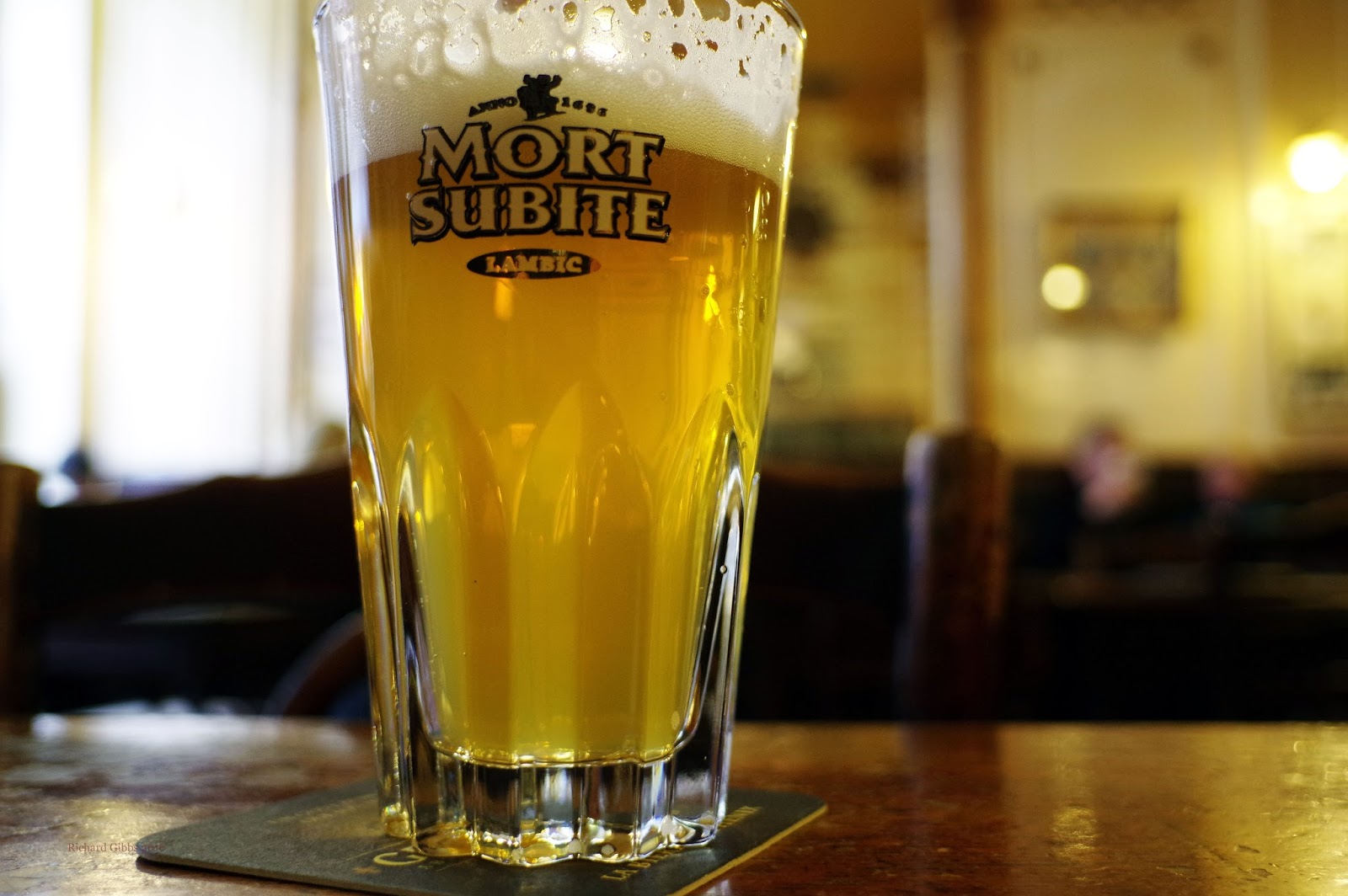
Some of the pictures published
herewith were taken in Brussels ,
the hot-bed of coca-cola quaffing Daesh sympathisers. My favourite bar, even maybe the best bar in
the world (pace, Eric Blair), is called Sudden Death (A la Mort Subite) where,
in the aftermath of Jacques Brel,
you can sit and sip lambic beer
staunched by une omelette fines herbes
avec pain et beurre.

If I am to die, one day, I feel I would perhaps prefer to be gunned down here by a (radicalised) Islamic fundamentalist, with a glass in my hand, than suffer a lingering, boring, suffocating death at the hand of a (radicalised) Nanny State whose principles are driven by the unintelligent, unimaginative (and uneconomic) use of dubious statistics…..

If I am to die, one day, I feel I would perhaps prefer to be gunned down here by a (radicalised) Islamic fundamentalist, with a glass in my hand, than suffer a lingering, boring, suffocating death at the hand of a (radicalised) Nanny State whose principles are driven by the unintelligent, unimaginative (and uneconomic) use of dubious statistics…..
Half a life-time ago I lived in a northern village. Sometimes I would walk to another village and sample a plate of fried whitebait, accompanied by a pint of something beerish. After my field-crossing walk I would enjoy the toasty warmth of a fire in the public house’s hearth. And I would not be the only one. Others, escaping the chill and boredom of their empty homes, would be huddled there, nursing a glass of succour, passing the time, and, perhaps, overhearing the voices of other human beings, rather than the piped voice of the Government through the speakers at ‘home’ (not unlike something in 1984...)

George Orwell knew a thing or two.
Yes, the National Health Service failed him on essential treatment for
tuberculosis, but he could see the life-enhancing social worth of the public
house, even though it was only a dream, even then....

The moon may be under water, but,
with careful management, the exchequer’s bills for health and social care could
be significantly reduced if Nanny let her hair down a bit and preserved the
Public House, with its associated comforts of tongue-loosening, sleep-inducing
malt liquor.

As I remember from when pubs were
pubs (ie Public Houses), and laughter was an innocent by-product of fermented malt:
There are many good reasons for drinking,
And one has just entered my head,
If a man can’t drink when he’s living,
How the hell can he drink when he’s dead?


