Showing posts with label John Craske. Show all posts

2 July 2026

South by South-West (Part 2)

Light and Shade in St Ives (again)


I don't think I could tire of this view.  It is from one of the rooms of Podn Olva, where I stayed in 2023, and where I stayed again this year.....

Pednolva, St Ives by John Anthony Park ROI (1878-1962)

Christopher (Kit) Wood stayed in the little wooden bungalow (which then had no hot water or toilet) here in the grounds of the Pedn Olva House Hotel, in the autumn of 1926. He was inspired by the light and colour.  

Here is a view of the rocky point from the harbour:

Pednolver, St Ives by Arthur Hayward (1889-1962)

And here is a view of the harbour itself:

St Ives by Alfred Cochrane (c1871-1947)

All of which go to show that St Ives has been popular with artists for quite some time, and that the stardom that arrived with Barbara Hepworth in 1939 was really part of a continuum, which eventually led to the creation of Tate St Ives in June 1993, designed, with echoes of the former gasworks on the site, by architects Eldred Evans and David Shalev.  The gallery was then enlarged by cutting into the cliffs by Jamie Fobert Architects in 2017.


Tate St Ives is a wonderful gallery, catching the light from the sea across Porthmeor Beach, and hosting works by local artists that include Alfred Wallis, Ben Nicholson and Barbara Hepworth.


And it was Barbara Hepworth who drew me here in March 2023 as the gallery was holding a major exhibition of her work then.  (For more about that please see:

Stringed Figure (Curlew) Version II 1956, edition 1959, By Barbara Hepworth

I really like her work, and though the above example may be called Curlew, I see in it the curls and colours of waves, and also the head of a great fish.....

Trewyn Studio, now known as the Hepworth Museum and Sculpture Garden, is almost as if Hepworth is still there.  Her studio has overalls hanging on the door,


And some of her tools are laid out as if she was about to start work....


Whatever her pieces are named, and whatever they are made of, I cannot help but feel the effect of the sea on them, the patient, timeless wear that creates smooth rocks and pebbles, but also the way that caves are formed, the way the incessant washing of the ocean sculpts forms where it meets the land.....


Hepworth's is a garden of earthly delights. A place to while away a sunny day in the shade of some glorious tree, musing on the turning of the world, the pull of the moon and sun, and the swish of the nearby sea.

Then, halfway between Trewyn and the Tate we find a tiny cottage, marked with a humble plaque.


This was the home of Alfred Wallis, who moved here with his wife in 1912, when he was 67.  Three years later Susan died, and Alfred took up painting, with household paints and bits of cardboard.  He painted from memory, scenes from his maritime experience as a young man. 

P.Z. 11 by Alfred Wallis c 1928

He never had tuition but his talent was recognised by Ben Nicholson and Christopher Wood when they chanced by on a day trip to St Ives in 1928.

The Blue Ship, c1934, by Alfred Wallis (1855-1952)

There is a similarity in Alfred's story to that of John Craske (see, if you will,
but, with respect to St Ives, it was his influence on Christopher Wood that was most significant.  As Sebastian Faulks describes in The Fatal Englishman, Wallis's work persuaded Wood to narrow his range of colour..... [and] what he really offered him was a renewed childlike directness.....

Cornish Fishermen, The Quay, St Ives, 1928 by Christopher Wood (1901-1930)

Christopher Wood died in Salisbury in 1930; Alfred Wallis lasted until 1952, and is buried in Barnoon Cemetery, overlooking Porthmeor Bay.  His grave is covered in ceramics by another artist who took up residence in St Ives, the potter Bernard Leach (1887-1979)....


St Ives is an enchanting place. Despite the changes brought about over the years by motor transport and the influx of tourists (like me) it still lives and breathes as a real place rather than as some kind of artificial Disneyworld.  The ever-changing Atlantic that ebbs and flows in and out of the harbour and over the sand and the rocks, the abundance of wildflowers on the island and along the coast, and the way the light rises and falls, shimmers and blurs, sparkles and fades - these all contribute to the magical appeal....  If I were an artist I would never cease to paint it from sunrise to dusk, through rain and mist and blazing cloudless heat.


Yes, if I could I would probably try and paint something like this, from a room in Pedn Olva:

Setting Sun Across The Bay, Albert Julius Olsson (1844-1942)

The town of St Ives has long been an artistic hub, attracting artists since the time of J M W Turner. They were attracted to Cornwall because of the beauty of the landscape and the quality of natural light. From the 1940s a circle of artists working in modern styles grew around St Ives. They contributed to international debates and developments in painting, sculpture and architecture, becoming pioneers of modern art. From this small Cornish fishing town, artists changed the international landscape of art, and of homes, towns and cities through their influence on subsequent generations of artists, designers, architects and makers. (From the Tate St Ives website).

I will go again.....

*****


South by Southwest [Shome mishtake?  Ed]
but it's all about the sculpture.....

*****

Dedicated to Eva Marie Sainte (who will be 102 on July 4th) and to my travelling companion

*****

4 April 2026

Life and death and love and loss on the Norfolk Coast

Resurrection at Eostre....


Part One:  Cromer

The sun doesn't go down over Cromer at this time of year - rather, it goes out, gently slipping away, fading, as the sea washes the shore and the town lights come on.  There's no one about, and the evening is ours.....


There's no one on the pier, no one to claim the crock of gold under the Lifeboat Station:

So we climb the companionway to 

Upstairs at No1

for a traditional platter of fish and chips....


After which we prowl the empty lanes:

Timidly passing the busy Red Lion:

Thinking that perhaps a drink in the bar at the Pavilion Theatre might be a quieter option:


However, finding that we are coinciding with the interval, with geriatric rockers spilling out from the auditorium, deafened by the 60's revivalist band, forming orderly queues at the bar, we turn towards the seemingly more sedate Hotel de Paris......

The hotel is part of a chain that caters mostly for busloads of pensioners..... 
Julia Blackburn, Threads
Where the Team welcome us:


And, here, while one aged holidaymaker sits nursing a pint and staring into the void, another group of pensioned revellers are enjoying double shots of Baileys at £4 a go.....


In the lounge the man in a faux-silk jacket and florid bow tie with the karaoke set-up energetically provokes an assortment of uber-retired couples to respond, "Who the fuck is Alice?" to his enthusiastic rendition of "Alice Doesn't Live Here Any More."  We walk on, not really surprised that after 24 years Alice has moved on....


Good night Cromer.....  It's been good to know you.....  [When I first saw the sign below, I misread it as "Germ of the Norfolk Coast...." But that is quite wrong:  make no mistake, Cromer really is a jewel....]


Part Two:  Sheringham


So, after Brancaster smoked haddock, spinach, poached eggs and sourdough, we leave the delights of Cromer, to park at West Runton and brave the full-on wind up and over the 200 or so feet of the Beeston Bump, where the wartime gun emplacement collapsed into the tunnels below and had to be replaced by a wooden effigy.  


It is a bracing, colourful morning, and the waves are coursing in from the churning sea.  Nothing, I guess, to an experienced fisherman, but it puts us in mind of the subject of our visit.


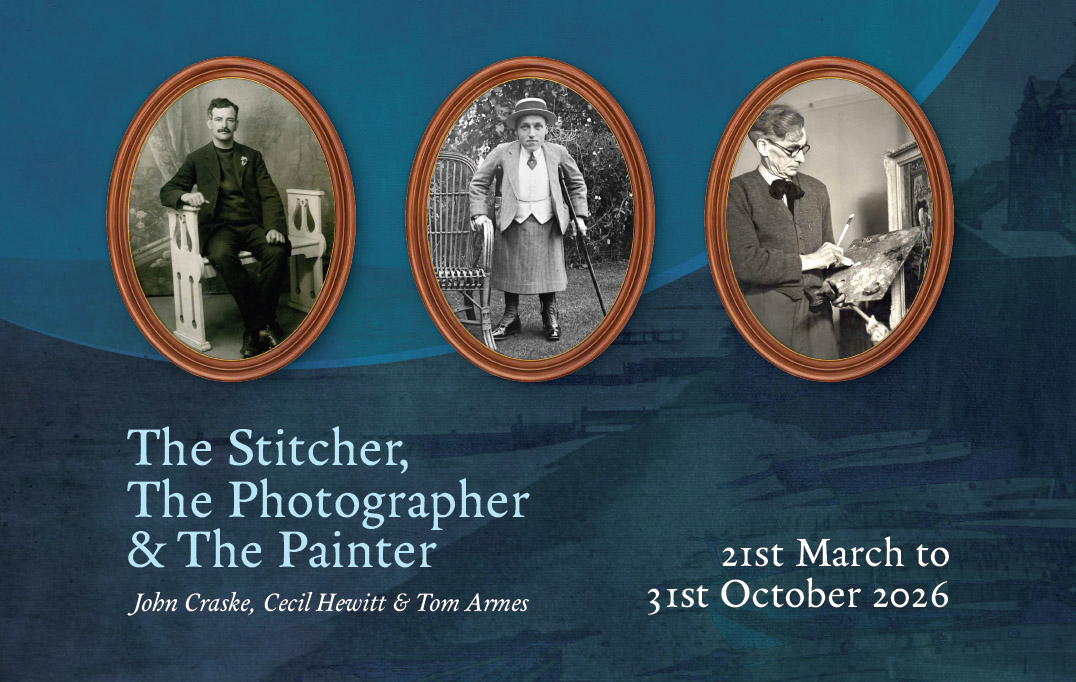
Which is an exhibition at Sheringham Museum:


Called:


OK.  I will be honest (for a change) and admit that I knew nothing about these three until recently [Like now? Ed], but thanks to my friend I have read: 


Which is a beautifully enlightening book about life and death, love and loss, centred on, as it says on the cover, the delicate life of John Craske [you may be able to blow this endpaper up, but if not, don't strain your eyes] - it says that Craske was a fisherman who, having become ill, spent the rest of his life painting and embroidering the sea life of North Norfolk, and that Julia Blackburn, in looking for the life of this man, while her own man died, treads an intriguing path along the Norfolk coast, finding footsteps in the sand, while swimming with her own sadness.


I don't believe this photo is really what it appears to be, but never mind.  The face is John Craske's.

Photograph by unknown, taken about 1901 - in the Public Domain

I want to share Craske's work and encourage others to visit the Sheringham Museum and appreciate the living reality of John Craske's art and life.....

Two masted steamer - watercolour
Reproduced with the kind permission of Sheringham Museum ©Sheringham Museum Trust

Some of these pictures are watercolours painted on wood, some oil on tin. Others, mainly later ones when he didn't feel so well, are embroideries.  Here, for example, is one which he stitched:

Reproduced with the kind permission of Sheringham Museum ©Sheringham Museum Trust

And, if you look at the back, you see how the short waves flutter while the sail billows at length:

Reproduced with the kind permission of Sheringham Museum ©Sheringham Museum Trust

He gets the wind, and the way the vessels ply with the frothing sea:

Steamer in Rough Seas - watercolour
Reproduced with the kind permission of Sheringham Museum ©Sheringham Museum Trust

He understands the way the wave motion can lift a boat from behind:

Reproduced with the kind permission of Sheringham Museum ©Sheringham Museum Trust

And how boats had to ride through the upsurging sea, even though it may have been ten or twenty years since he had been a fisherman himself:

Reproduced with the kind permission of Sheringham Museum ©Sheringham Museum Trust

And you can tell how he knew and loved the interaction of land and sea that is such a part of the North Norfolk coast:

Coastal View with Cottages
kindly donated by Madeline Weston
Reproduced with the kind permission of Sheringham Museum ©Sheringham Museum Trust

I encourage you to imagine these pictures as John himself would have imagined them. We don't have his past experience, but by immersing ourselves in the image we can perhaps imagine his imagination:

Reproduced with the kind permission of Sheringham Museum ©Sheringham Museum Trust

Here is one of his textile pictures of the Norfolk coast, which is real, as real as art ever is.  It was woven with love, and found its way, via Peter Pears, to the Red House in Aldeburgh:


Beach Scene: The Foreshore 
John Craske (1881 - 1943)
The Red House, Aldeburgh
licensed under CC BY-NC-ND


I love these pictures. John Craske became ill after enlisting in the army in 1917, at the age of thirty-six, and never really became an easily functioning man again before his death in 1943. He was loved and looked after by his wife, Laura, who, for some time, was pushing him in a wheel chair from their cottage in Wiveton to Cley (maybe two miles each way) every day so that he could be by the sea....

But he came from a family of fishermen and served his time in his youth on boats that were tossed and shaken by high seas. He was therefore able to express the shifting forms of water around the buoyed shapes of vessels in all weathers....

Here is one of his paintings that lives at the Red House:


Hauling the Codliner
John Craske (1881 - 1943), 
The Red House, Aldeburgh 
licensed under CC BY-NC-ND


You can feel the shifting waters, and hear the wind, and smell the salty water, whichever way the wind blew, or the sea lifted, or the sails were set....

In the late 1920s, Molly Turpin, soon to be known as Valentine Ackland, wrote that Craske is undoubtedly a very great artist.....  He is middle-aged, tall, burly; he wears a blue sailor's pull-over and his eyes are blue and bright.  He has a stern, intellectual face, with a beaky nose and fine bones.  He is decisive and clear-thinking, but without any blanketing of theory or art-talk. He paints from he calls 'memory' and when he was telling me about two pictures of coastline he said that one's Yorkshire and that one is Imagination. he knows the exact history of every boat he paints, the story of how a boat looked, where she went, what the weather was like and who was aboard her......

We leave the. museum and wander in Sheringham, making friends with the local people, who have stored memories of life and death here - of love and loss:


It is not sure exactly what it was that afflicted John, but he was diabetic, and may have had some problem with his pituitary gland. For long periods he was in a semi-comatose state, or just listless, and had difficulty walking. He painted on all available surfaces in their accommodation, but then, when too tired to sit and paint, he took up embroidery and stitched scenes of the life he had known, and the life he imagined (his last, unfinished, work was a five-yard long embroidered depiction of the evacuation from Dunkirk, currently in the Norwich Castle Museum....)

The sense of history and culture and tradition here in Sheringham is very strong:


And the town is proud of its artistic heritage, which celebrates the lives of those who didn't hesitate to give for others:


Given John's ill health, his background, his education, and the cost of materials, his output was remarkable. And, given all that, his optimism and clear love for his subject are to be admired, and his story, as told by Julia Blackburn and evidenced in various sources, is inspirational.  

Life, I think, is not just about the living.  And art, I think, is sometimes a gift from one to another, something to share and treasure, something to value not as a private possession but as a common experience.

The sea is everywhere here.  A wall lobster startles me in an otherwise quiet lane:


In the Peter Coke Shell Gallery I am reminded of Ariel's song to Ferdinand:

Full fathom five thy father lies;
Of his bones are coral made;
Those are pearls that were his eyes:
Nothing of him that doth fade,
But doth suffer a sea-change

And on the slipway outside the Fisherman's Lifeboat Museum small boats seem safe:


Until you think about the relentless swash of the sea, even at its mildest:


And then images come to mind of ships creaking and groaning among the waves as a headwind whisks the water to spume.  

Thank you John.

And thank you Julia.


We turn away from Sheringham, walking back into our lives, but stronger, perhaps, for what we have seen.


In Threads, Julia Blackburn has written a book about life and death and the strange country between the two where John Craske seemed to live.  It is also about life after death, as Julia's beloved husband Herman, a vivid presence in the early pages of the book, dies before it is finished.


There were some lovely paintings and embroideries.  I especially liked the one of a ship in a storm done in all sorts of greys, but above all I liked the tiny slip of an image that had dropped out of the prayer book.  John Craske had written his name in black paint in careful but shaky capital letters in the bottom right-hand corner and he had written PEACE BE STILL over the top of the image.

Julia Blackburn
Threads

Reproduced with the kind permission of Sheringham Museum ©Sheringham Museum Trust
kindly donated (I think) by Madeline Weston


******

The strange thing about growing old is that the intimate identification with the here and now is slowly lost; one feels transported into infinity, more or less alone, no longer in hope or fear, only observing.

Albert Einstein 
in a letter to the Queen Mother of Belgium, 1953

(Quoted in Threads)


******

For my friend and companion on this adventure


******