Showing posts with label St Mark's. Show all posts

21 March 2025

Venice unmasked

Dimenticare Venezia


In 1892, in Italian Hours, Henry James wrote that, Venetian life, in the large old sense, has long since come to an end, and the essential present character of the most melancholy of cities resides simply in its being the most beautiful of tombs.

 
In 1956, Mary McCarthy (an American critic and novelist, 1912 – 1989) wrote, in Venice ObservedAnd there is no use pretending that the tourist Venice is not the real Venice, which is possible with other cities – Rome or Florence or Naples.  The tourist Venice is Venice: the gondolas, the sunsets, the changing light, Florian’s, Quadri’s, Torcello, Harry’s Bar, Murano, Burano, the pigeons, the glass beads, the vaporetto.  Venice is a folding picture postcard of itself.

 
Both these statements, I believe, ring true today, but neither should be taken as the last word. Many other writers have added their pennyworths to the pile of thoughts that Venice inspires.  Charles Dickens, in Pictures from Italy (1846) dreamt of buildings that were high and low, and black, and white, and straight, and crooked; mean and grand, crazy and strong.....  He fancied he saw old Shylock passing to and fro upon a bridge, all built up with shops and humming with the tongues of men.....  Jan (then James) Morris wrote in 1960 that, In Venice the past and the present are curiously interwoven.....and that Melancholia contributes strongly to the Venetian atmosphere.  


Joseph Brodsky, in Watermark (1992), referred to the chiming of bells, his room flooded with this outer, peal-laden haze, which is part damp oxygen, part coffee and prayers.....  


More recently, in Venice is a Fish (2000), Tiziano Scarpa suggests that the visitor to Venice should put on very dark sunglasses....  Venice can be lethal, he says.  In the historic centre the aesthetic radioactivity is extremely high.  


Every angle radiates beauty; apparently shabby; profoundly devious, inexorable.  The sublime pours in bucketloads from the churches, but even the calli without monuments, the bridges to the rii, are picturesque at the very least.


My love affair with Venezia has lasted almost fifty years, though over those years we have both aged and changed.  It may be a platitude to say that the magic has worn a little thin, and that I feel a little less excited about our relationship than perhaps I did when I first set foot in La Serenissima.  But I guess the feeling is reciprocal – she loves me a little less too.  I am just one of millions of admirers, and the restauranteurs and the gondoliers know it.  

There is nothing special about me.

So, during my recent stay, in a tiny quiet apartment above a courtyard in the Santa Croce sestiero, 


a step away from the delightful Campo San Giacomo dell’Orio, 


I retrace the steps of many years, revisiting the great churches of the Frari and Saints Giovanni and Paolo, the Salute, 


San Giorgio Maggiore, as well as, of course, San Marco.  


I climb campanili to see the views across the city and the lagoon to the distant Dolomiti.  


I wander over the Rialto, through the markets, through the Correr, the Accademia, the Scuole (dei Carmini, Grande di San Rocco, 


di San Giorgio degli Schiavoni), the Guggenheim, 


the great Palazzi (Ducale, Ca’ Rezzonico, Ca’ Pesaro).  I visit La Fenice (for Il Barbiere di Siviglia), having not been there since I went with Amanda before the fire....  I visit the campi (too many to mention) and the islands (Murano with its flamboyant glass, multi-coloured Burano, 


silent Torcello, 


the Lido with its Adriatic strand 


and Giudecca with its busy boatyards).....  


In the Arsenale we see a magical show about Casanova, boats and floats and acrobats, and projections on fountains. 


And with every step come memories but also new pleasures as the light changes, and I see things I hadn’t noticed before.  The Carnival adds spice and splendour, 


the old Bacari replenish flagging spirits, 


various trattorie fill my belly (but drain my wallet) with bigoli in salsa, risotto di nero di seppia, pasta e fagioli, moleche (soft-shelled crabs), branzino (sea bass), pesce san Pietro (John Dory), all lubricated with copious glasses of Tai (Venetian Tocai) or Soave (et alios).....  


My love is rekindled and, as the weather turns from rain and cold to crystal clear skies and gentle breezes, I relax into a routine of living once more all’Italiana: a cappuccino and cornetto con crema at Lavena, then a walk, as Tiziano Scarpa recommends: The first and only itinerary I suggest to you has a name.  It’s called: at random.  Subtitle: aimlessly.....  Getting lost is the only place worth going to.....  I feel a new sense of delight in every calle, every sottoportico, every campo.  Here you can sit and dream.  Here you can immerse yourself in a book 


or just take the sun with your floppy dog.  


There you can compose a sketch, 


or sip a spritz. 


I like to watch the world go by.  It is reassuring to see people going about their lives in this timeless place.  


And I love to exchange a cheeky glance here and there.....


And then as the days spin away, the sun falls, 


the moon and stars appear above the rooftops, 


and the canals become deep dark alleys lit only by the occasional lamp.  I love the close dark silence, just sometimes broken by a lonely splash.  I love the mellow warmth of the crumbling walls.  


It can be eerily quiet – so many palazzi now are uninhabited, and very few are the animal sounds of the night.


I even get so lost in my reveries that I photograph a man with a mop of silver hair leaning on a bridge without realising who he is.  


Later I discover that if I had £8,450 to spare I could have indulged in six days (partly) in the company of acclaimed architect and descendant of an ancient Venetian dynasty, Francesco da Mosto to discover the layered history of the Floating City, exploring its waterscapes, architecture and artworks.  

Ah well!  Another time....


But will there be another time?  There are other places.  Beautiful and unique as Venice is I feel this may have been the last time.  So now, perhaps, is the time to forget Venice, as in Dimenticare Venezia, the 1979 film written and directed by Franco Brusati which was nominated for an Oscar for Best Foreign Language Film, but which tied for the 1979 David di Donatello Award for Best Film with The Tree of Wooden Clogs and Christ Stopped at Eboli (it was a very good year!)


The film isn’t really about Venice at all, but I know it because one of my students at the time had a role in it and that was quite something. The main point here is that there comes a time when decisions must be made, and relationships may be more important than seeking diversion in fanciful plans.  


I love Venice, and had a really good time there this year, but perhaps I should acknowledge that there are alternatives to beating on, boats against the current, borne back ceaselessly into the past (F Scott Fitzgerald, The Great Gatsby).


To quote Henry James again, this time from 1882 (Italian Hours), When I hear, when I see, the magical name I have written above these pages [Venice], it is not of the great square that I think, with its strange basilica and its high arcades, nor of the wide mouth of the Grand Canal, with the stately steps and the well-poised dome of the Salute; it is not of the low lagoon, nor the sweet Piazzetta, nor the dark chambers of St Mark’s.  I simply see a narrow canal in the heart of the city – a patch of green water and a surface of pink wall.....


Basta.

*****


*****


I wrote another piece about Venice on this blog some fifteen years ago (updated, I think, a year or two after).  If you have the stamina, have a glance:

https://www.richardpgibbs.org/2010/04/venezia-venice.html


And then, if you need some light relief, join in with Joe Dolan's audience in this jolly piece of theatre.....


******


{For Sarah H}


*****


16 August 2013

Bristol 2 - Arcs and Arches

A Window on Bristol

'Window on Bristol' by Andy Council and Luke Palmer (Acerone), 2011

The Clifton Suspension Bridge is one of Bristol's key landmarks: its bold leap across the Avon gorge was not completed until 1864, five years after Brunel's death (at the age of 53) but it was his masterpiece and is now a symbol not only of Bristol but also of Victorian engineering achievement.

The art, or science, of spanning any gap, however, goes back to the beginnings of time, and Stonehenge shows how early man did it. Very strong uprights and a strong cross-beam (lintel) did the trick.  This was good enough for the trabeated architecture of the Greeks, but the limitations of this led to the Romans developing the arcuated style. This used the semicircular arch which could expand the distance between uprights and carry much more load overall. Arches became the staple of the Romanesque style of architecture employed by the Normans throughout Western Europe in the Middle Ages.


Interlocking Romanesque Arches in the Chapter House of Bristol Cathedral, showing one way that Ogival Arches (the defining characteristic of Gothic architecture) can be created.

Another fine arch in Bristol is that beneath the church of St John's, which was built in the 14th century when a new outer wall to the city was constructed, (the two smaller portals are only about two hundred years old).


Outside the city walls the Lord Mayor's Chapel, or St Mark's, originally the Chapel of the Hospital of the Gaunts, is partly thirteenth century, 


and within this are some ornate tombs, including those of the founders of the hospital, certain merchants and two crusaders.


Another Bristol church where the arches reach up to vault across the ceiling is St Mary Redcliffe, the gold leaf on 1200 bosses glittering as they have done for centuries. There has been a church here for about one thousand years, though much of what you see now is fourteenth century. Queen Elizabeth I is said to have described it as "the fairest.... parish church in England" and both Robert Southey and Samuel Coleridge were married at its altar. 


The East End of Bristol Cathedral, which includes the Elder Lady Chapel (completed in 1220), is, according to Nicholas Pevsner, "superior to anything else built in England and indeed in Europe at the same time," though the Nave and West End were completed in Gothic Revival style in the late 19th century. Another of its glories is the Chapter House (see above), but the effect of having the choir, the nave and the aisles all at the same height is inspiring.


The Nave

The Choir

The theme of arches was not restricted to the ecclesiastical world.  As the importance of Bristol as a port grew, several buildings were designed which went beyond the purely functional.  Much of central Bristol was destroyed in bombing raids between November 1940 and April 1941, when almost 1,000 tons of high explosive and incendiary bombs were dropped on the city in six major raids (one of which lasted twelve hours). German pilots found the city by following the glimmer of moonlight up the Avon, and Bristol was the fifth most heavily bombed British city in WWII.  1,300 people were killed and 90,000 buildings were damaged, including the Temple Church, which now stands roofless in Castle Park.

Some great buildings survived the war, however, though in certain cases they have not fared so well since.  The old carriage works at 106 Stokes Croft was built in 1862 in what is known as Bristol Byzantine style. The decoration seen here is much later.


Graffiti Art within the Arches - on the right a community project


Built in 1869, between Queen Charlotte Street and Welsh Back, just by the Floating Harbour, The Old Granary building is the epitome of the round-arched style known as Bristol Byzantine. The design was much influenced by the Arts & Crafts movement (William Morris et al) and its form was both decorative and practical for the drying and handling of grain. The particular character of this building derives from the Cattybrook bricks which came from Almondsbury, just to the north of the city (the same brickworks provided not only the materials for the Old Fish Market - now a pub - but also for the 1872 Severn railway Tunnel, which used thirty million of them).


Another remarkable building, also indebted to William Morris (who is depicted on the facade) is the Edward Everard printing works which was built in 1900, the ground floor deliberately echoing the arches under nearby St John's.


And one of the last great gothic buildings to be built in this country was the Wills Memorial Building of the University of Bristol.  Within this complex is the Great Hall, which can seat 800.  This was commissioned in 1912, but due to WWI was not completed until 1925.  The Hall was then badly damaged in the Bristol Blitz and not restored until 1960.


Naturally other decorative arts have been practised in Bristol, and one of its best known paintings is Henrietta Mary Ada Ward's "Thomas Chatterton" which was painted in 1873, (though the most famous aspect of this picture may be that John Everett Millais added the kitten's tail before it was exhibited at the Royal Academy).


There are galleries in Bristol, from the Bristol Museum and Art Gallery, to the Royal West of England Academy of Arts, to Spike Island to the Arnolfini (itself a magnificent building, where a recent exhibition of work by Ian Hamilton Finlay touched back to the gallery's foundation in 1961).


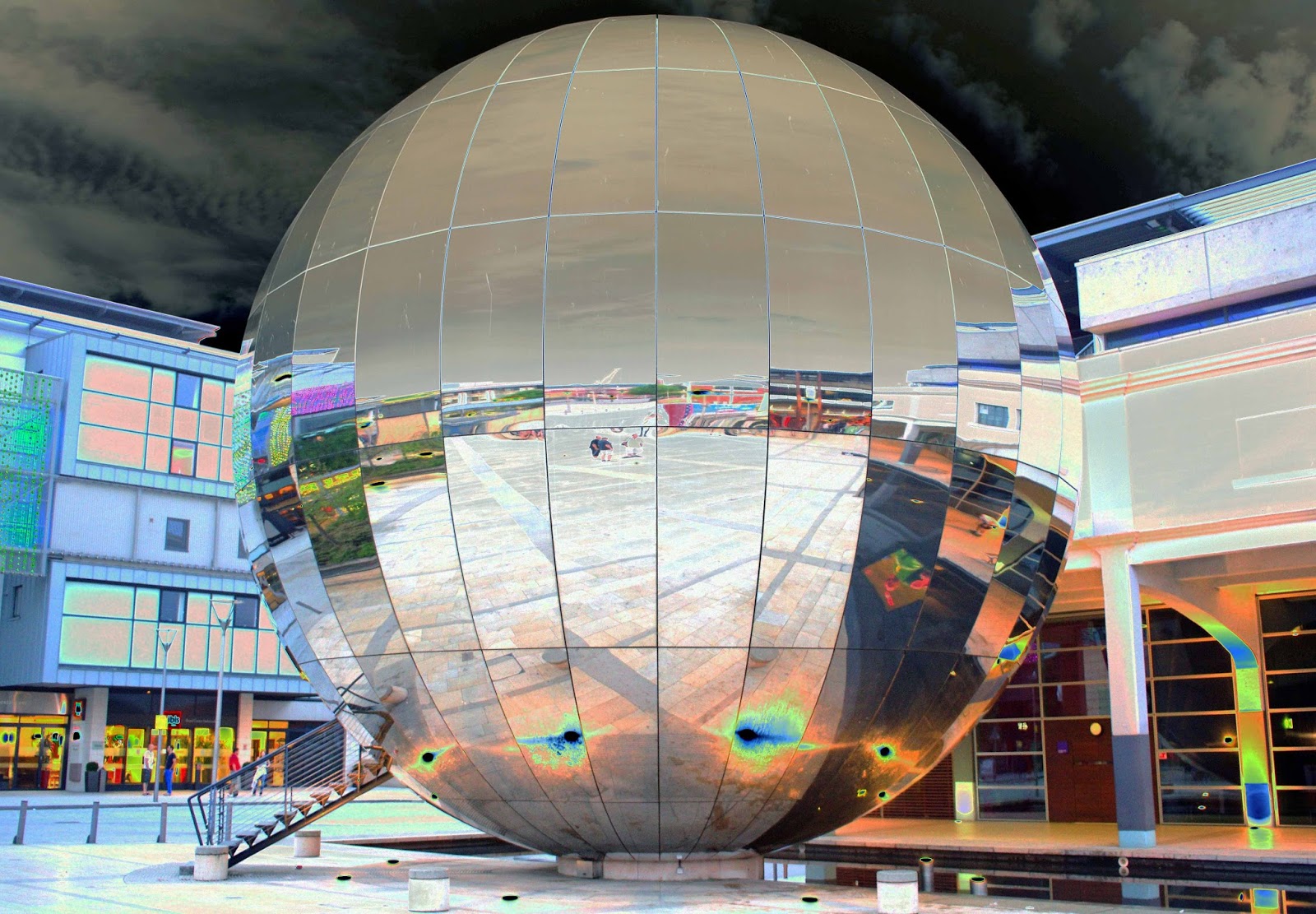
More recently, Explore@Bristol was developed, using a great deal of glass and concrete, but also providing the site for the Orange Imaginarium, designed by Wilkinson Eyre, and reflecting the light, and activities, of the Harbourside.


And then there are the walls, and corners, and gates and doorways of Bristol where Street Art has been developed to world class.


Artwork by Nick Walker

Some of these are unsigned, anonymous and collaborative.  And they themselves become the ground for further decoration, sometimes effective and sometimes not.


Work by Philth under a famous Banksy piece


On Stokes Croft, Cosmo Sarson has created a giant mural inspired by a breakdance performance for Pope John Paul II in 2004:


Nearby, fences and buildings are covered in bright graffiti and stencils: 


An alleyway off Stokes Croft has been colourfully enhanced:


And on the way to St Paul's a gateway has been signed:


Most famous of these artists is Banksy, who was born in Bristol (in 1974) and who now banks megabucks for his authenticated work. He was involved in the Bristol Street Art explosion, has worked all over the world, but had a phenomenally successful exhibition at the Bristol Museum and Art Gallery in 2009.

One of his best known pieces is on the wall of a former clinic in Frogmore Street. This work, entitled "Well Hung Lover" went up in 2006, but was damaged by paintball shots in 2009.  Controversy then arose when Philth added his work at the foot of the wall.


Banksy, and me.....


Bristol is a vibrant and imaginative place to be.  Almost all the pictures in this and my two other posts on Bristol, were taken within 24hrs earlier this month.  The city is relatively compact, so I walked everywhere, and all the art was on display for free.  From the Normans to Inkie, there is a huge span of ideas and purposes, but the arc of the rainbow has crocks of gold at either end. My pictures do not do justice to the range and quality that is on display, nor to the dimensions to be experienced in person.  Go see for yourselves! 

Take a balloon ride.....


http://www.bristol-link.co.uk/entertainment/explore-at-bristol.htm

http://visitbristol.co.uk/things-to-do/galleries-and-exhibitions

http://visitbristol.co.uk/things-to-do/banksy-walking-tour-p1354013

http://www.wherethewall.com/bristolstreetarttours


http://mshed.org/